
However, the production of high-quality flavour powders places high demands on process engineering. Mixing technology, in particular, plays a key role in this. As flavourings are often added in very small quantities, it is essential to ensure that they are distributed evenly throughout the product. Even minor variations can lead to significant differences in taste and thus compromise product quality.

Explosion of flavours
Explosion of flavours
Basics of powder processing
Powder processing refers to all the steps required to produce a ready-to-use powder with defined properties from various raw materials. Depending on the product, this may involve processes such as grinding, sieving, drying, agglomeration and mixing.
In the case of flavouring powders, the actual flavouring substances are often applied to what are known as carrier substances. Typical carrier materials include maltodextrin, starch, dextrose or gum arabic. These substances serve to stabilise the sensitive flavouring components and facilitate handling during production. At the same time, they make it easier to measure out the flavourings, which are often highly concentrated.
The quality of the final product is largely determined by the homogeneity of the mixture. The aim is to achieve the same concentration of flavourings in every portion of the product.
Requirements for flavouring powders
Flavour powders must meet a number of requirements in order to be used reliably in industrial processes. In addition to good shelf stability and free-flowing properties, the even distribution of flavour components is particularly crucial. The product must not segregate during either transport or storage. Furthermore, flavour losses due to evaporation or oxidation must be kept to a minimum.
As many flavourings are highly sensitive to temperature, oxygen and mechanical stress, all stages of the process must be carefully coordinated.
Mixing techniques in the processing of flavouring powders
The term ‘mixing technology’ refers to the deliberate combination of several substances to form a mixture that is as homogeneous as possible. In powder processing technology, the aim is to distribute the individual particles throughout the product in such a way that every sample taken has the same composition. This is particularly important in the case of flavouring powders, as flavourings are often used in very small quantities and even minimal differences in concentration can lead to perceptible variations in taste.
The quality of a mixing process is therefore largely determined by the degree of homogeneity achieved. At the same time, delicate raw materials must be handled with care in order to preserve their functional properties and flavour profile.
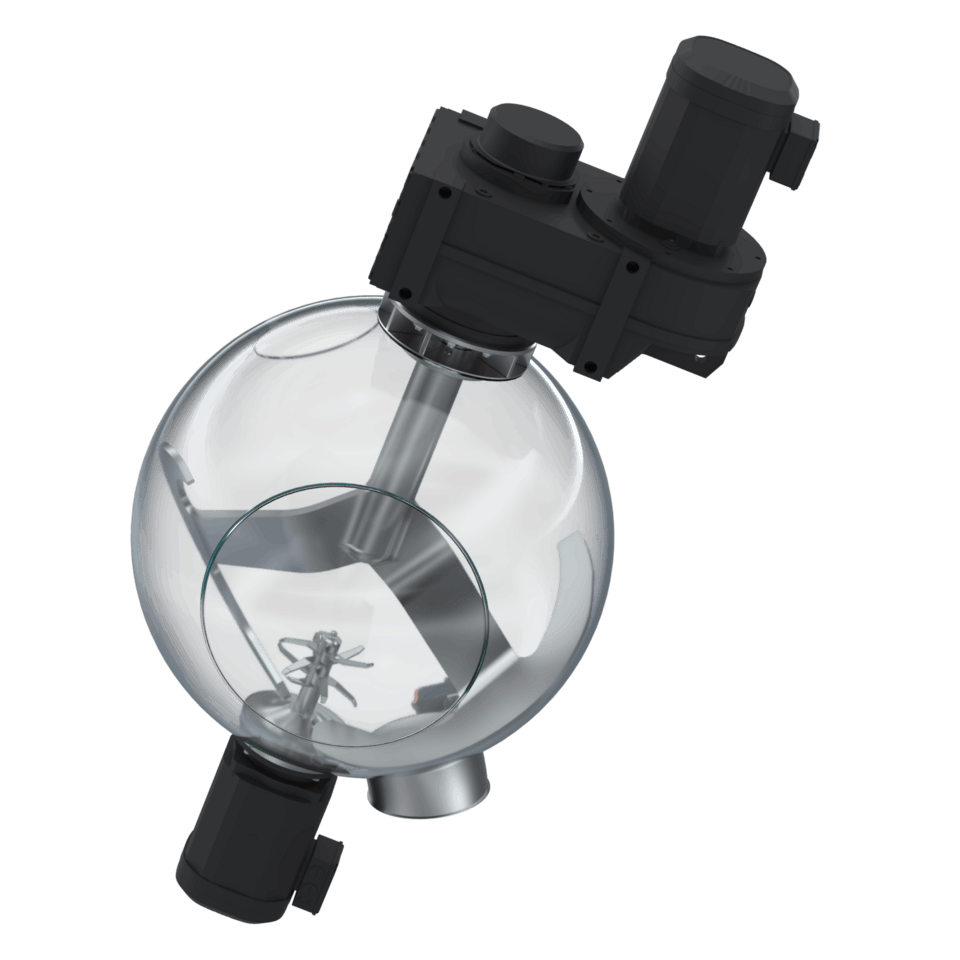
Mixing principle of the GloMix Glaxiaris mixer
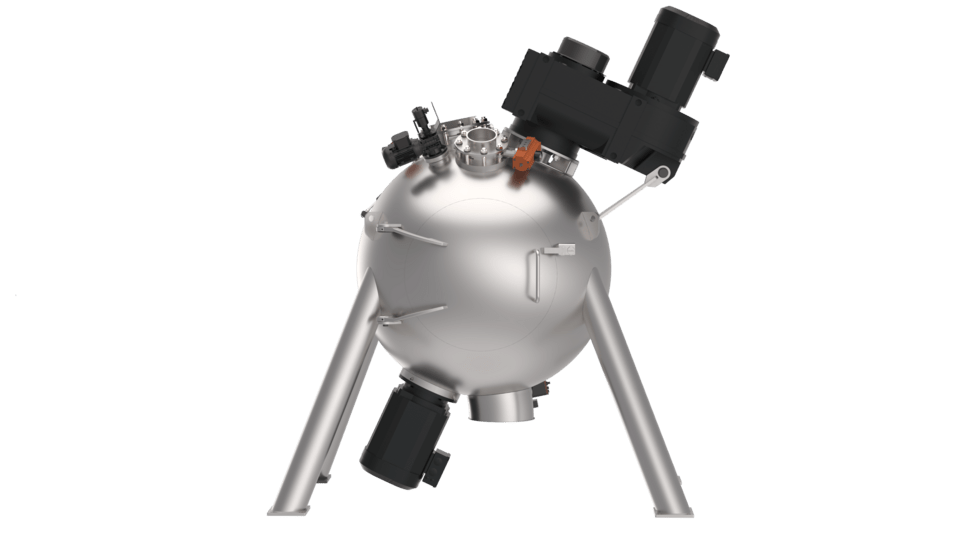
The GloMix Glaxiaris® mixer is based on an innovative mixing principle that differs significantly from conventional ribbon, ploughshare or double-cone mixers. At the heart of the system is a spherical mixing chamber, the axis of rotation of which is inclined by 23°. Thanks to this special geometry, the material being mixed is continuously moved in all directions during rotation.
Unlike conventional mixing systems, no preferred flow directions are created within the product. Instead, the particles are constantly rearranged, resulting in three-dimensional mixing. This movement enables the even distribution of powder particles, granules and liquid components in a very short time.
This mixing principle offers significant advantages for the processing of flavouring powders, as it allows both fine flavouring carriers and larger raw materials to be distributed evenly.
Gentle handling of products
A key consideration in the production of flavour powders is the protection of sensitive ingredients. Many flavour components consist of volatile compounds that can be lost if subjected to high mechanical stress or elevated product temperatures.
The spherical mixing chamber of the Glaxiaris® mixer reduces friction between the particles. At the same time, there is no need for high-speed mixing tools that would subject the product to unnecessary stress. Energy is primarily transferred through the movement of the entire batch rather than through intense shear forces.
This ensures that the product is handled with particular care and helps to preserve the quality and intensity of the flavourings used.
Homogenisation of flavour mixtures
Homogenisation refers to the process of achieving the most uniform distribution possible of all components within a mixture. This poses a particular challenge with flavouring powders, as the flavouring components often make up only a very small proportion of the overall formulation.
According to the manufacturer, the GloMix Glaxiaris® mixer achieves homogeneity levels of over 99%. This is made possible by the constant redistribution of particles within the spherical mixing chamber. The individual components are continuously redistributed, thereby quickly balancing out local variations in concentration.
For industrial production, this means a high level of process reliability and consistent product quality throughout the entire batch.
Mixing accuracy
Mixing accuracy describes how evenly the individual components are distributed within a batch. In powder processing, it is often assessed using statistical measures such as the standard deviation or the coefficient of variation (CV). The smaller the variation in concentrations across different samples of a mixture, the higher the mixing accuracy.
This parameter is particularly important when it comes to flavouring powders. As flavourings are often used in very small quantities — just a few parts per thousand or per cent — even slight variations in distribution can lead to noticeable differences in taste. A high degree of mixing accuracy is therefore essential for consistent product quality and reproducible sensory properties.
The three-dimensional product movement within the GloMix Glaxiaris® mixer ensures that both primary and trace components are continuously redistributed. The spherical mixing chamber prevents the formation of dead zones or preferred flow paths, which can occur in conventional mixing systems. This allows even low-dose flavour components to be incorporated into the overall mixture with a high degree of precision. For the user, this means high batch consistency, reliable adherence to formulation specifications and assured reproducibility of product properties across many production cycles.
Incorporating liquid flavourings
In addition to powdered flavouring ingredients, liquid flavourings and essential oils are also frequently used in the food industry. Ensuring the even distribution of such liquids poses a challenge for many mixing systems.
The GloMix Glaxiaris® mixer allows liquid components to be added directly during the mixing process. The liquids are introduced into the mixing chamber via special nozzles and are immediately distributed by the three-dimensional movement of the product. This ensures that the carrier particles are evenly wetted without the formation of lumps or localised over-concentrations.
This process enables the production of high-quality flavour powders with a uniform distribution of liquid active ingredients and flavourings.
Cleaning and product changeover
In flavour production, different formulations are often produced on the same production line. This is why the cleanability of the mixing plant is of particular importance.
The smooth internal geometry of the spherical mixing chamber ensures that the contents are emptied almost completely. This helps to minimise product residues. Furthermore, wet and dry cleaning procedures can be carried out efficiently. This reduces downtime and minimises the risk of cross-contamination between different flavour batches.
This is a significant advantage, particularly when it comes to high-quality products or those containing allergens.
Energy efficiency and cost-effectiveness
In addition to product quality, the cost-effectiveness of modern mixing systems is playing an increasingly important role. Thanks to the special geometry of the mixing chamber, the Glaxiaris® mixer operates with low energy consumption. The movement of the material being mixed is efficient, as unnecessary friction losses are reduced.
Several process steps, such as homogenisation, wetting, deagglomeration and coating, can be carried out simultaneously within a single system. This reduces both processing times and capital and operating costs.
Conclusion
The processing of flavouring powders places particularly high demands on mixing technology, as it is essential to ensure the even distribution of minute quantities of flavouring whilst handling the sensitive ingredients with care. The GloMix-Glaxiaris® mixer offers a mixing concept specifically designed for this purpose. The spherical mixing chamber, with its 23° inclined axis, creates a three-dimensional product movement that enables a very high degree of homogeneity whilst requiring minimal energy input.
Manufacturers of flavouring powders, in particular, benefit from the gentle handling of the product, the efficient incorporation of liquid flavourings and the system’s excellent cleanability. The combination of high mixing quality, flexibility and cost-effectiveness makes the GloMix-Glaxiaris® mixer a high-performance solution for modern powder processing and flavouring production processes.