
Powdered foods are among the most important product groups in the modern food industry. They are characterised by a long shelf life, low transport weight and ease of preparation. Instant soups and sauces, in particular, are hugely popular as they are ready to eat within a few minutes whilst offering consistent product quality. To ensure these products meet consumer expectations, they must fulfil numerous requirements regarding flavour, solubility, shelf life and ease of portioning. The production of such foods therefore requires a thorough understanding of the raw materials used, as well as the physical and technological processes involved.


Composition of powdered foods
Instant soups and instant sauces consist of a wide variety of different ingredients, each of which fulfils a specific function. The most important ingredients include starch, flour, milk or whey powder, vegetable fats, sugar, salt, as well as spices and herbs. In addition, many products contain vegetable flakes, dried meat ingredients, proteins, yeast extracts or flavourings. Depending on the recipe, thickening agents, emulsifiers or anti-caking agents are also added to improve processing and subsequent preparation.
Individual raw materials often vary considerably in terms of particle size, bulk density, moisture content and flowability. These differences place high demands on the manufacturing process, as all components must be distributed evenly to ensure consistent product quality.
Requirements for instant products
Consumers expect instant products to be easy to use and to be of consistently high quality. The powder should dissolve quickly in water, with as few lumps as possible, and form a smooth soup or sauce within a short time. At the same time, the flavour, consistency and appearance must be identical every time the product is prepared.
In addition to its sensory properties, technical characteristics also play an important role. The powder must retain its free-flowing properties, be easy to measure out accurately, and must not segregate or clump during storage or transport. Furthermore, the product should generate as little dust as possible and integrate seamlessly into industrial packaging systems.
Physical properties of powdered foods
Powdered foods possess a number of physical properties that significantly influence their behaviour during production, storage and use. These include, in particular, particle size, particle size distribution, bulk density and flowability.
Although fine powders often mix well, they are more prone to dust formation and can form agglomerates more easily due to intermolecular forces. Coarser particles, on the other hand, are usually easier to measure out, but often take longer to dissolve completely. Moisture absorption also plays a crucial role. Even small amounts of water can cause powders to clump and lose their free-flowing properties. For this reason, powdered foods are produced under controlled climatic conditions and stored in moisture-proof packaging.
Solubility and wetting behaviour
A key quality characteristic of instant soups and instant sauces is their rapid solubility. Once water has been added, the individual ingredients must be moistened as quickly as possible so that they can disperse evenly and fulfil their respective functions. Starch swells and provides the desired viscosity, spices and flavourings are distributed throughout the product, and fats form stable emulsions.
The speed of this process depends, amongst other things, on the particle structure, particle size and wettability of the individual components. Powders that absorb water with difficulty tend to form lumps and significantly prolong the preparation time. For this reason, many instant products are specifically agglomerated or optimised in terms of their surface properties to enable rapid water absorption and uniform dissolution.
Hygiene and food safety
The manufacture of powdered foodstuffs is subject to strict hygiene requirements. All stages of production must be carried out in such a way as to rule out any microbiological contamination. At the same time, no foreign substances or residues from previous production batches must find their way into the final product.
Particular attention must be paid to allergenic ingredients such as milk, gluten, celery and mustard. Modern production facilities therefore operate in accordance with comprehensive hygiene protocols and adhere to international standards such as HACCP. Furthermore, all machinery must be easy to clean and designed in such a way as to prevent product residues.
Challenges in manufacturing
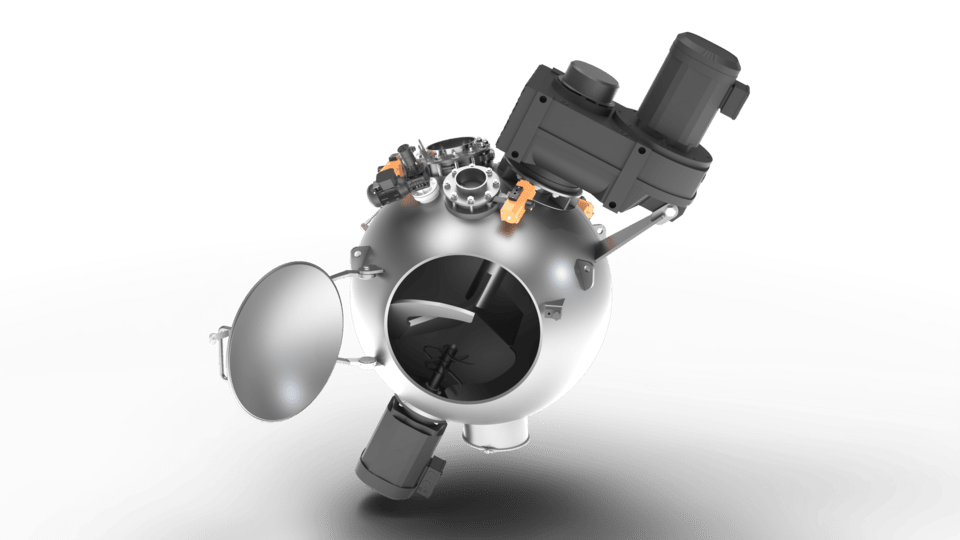
The industrial production of powdered foodstuffs presents numerous process engineering challenges. Different raw materials must be distributed evenly despite their varying physical properties. At the same time, delicate ingredients such as herbs, vegetable flakes or freeze-dried components must not be damaged during processing.
Preventing segregation also plays an important role. During transport within the production plant or whilst filling the packaging, particles of different sizes or densities may separate from one another. This would result in individual packages no longer containing the intended composition. Therefore, both the formulation and the production process must be carefully coordinated.
The importance of mixing technology
Mixing technology is at the heart of the production of powdered foodstuffs. Its aim is to blend all raw materials evenly, regardless of their differing properties, and to ensure consistent product quality. Modern mixing processes enable the homogeneous distribution of even the smallest quantities of spices, flavourings or functional additives, whilst preventing damage to sensitive ingredients.
Furthermore, the mixing technique has a significant impact on the product’s subsequent functionality. An even distribution of the ingredients improves solubility, promotes rapid wetting during mixing and ensures that the flavour, colour and consistency are identical in every portion. At the same time, short mixing times, low energy consumption and a high level of process reliability can significantly enhance the cost-effectiveness of production.
Benefits of GloMix Glaxiaris®
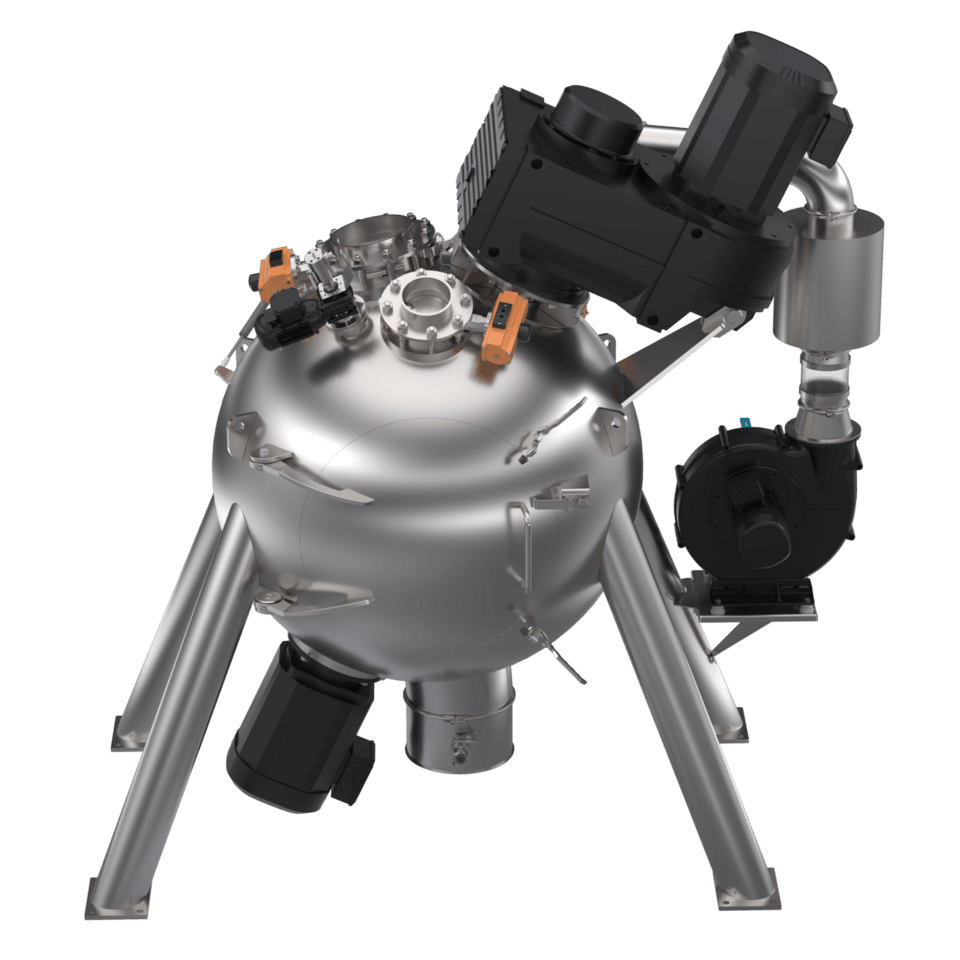
The GloMix Glaxiaris® offers ideal conditions for the production of high-quality instant products. Thanks to its high-performance mixing technology, it enables a particularly homogeneous distribution of a wide variety of powder components, even when these exhibit significant differences in particle size, bulk density or flow properties. At the same time, the mixing process is gentle on the product, ensuring that sensitive ingredients such as herbs, spice particles or vegetable flakes retain their structure and quality.
The efficient flow pattern within the mixing system promotes uniform wetting and distribution of all ingredients and helps to minimise segregation and clumping. This improves both solubility and the subsequent preparation of instant products. Furthermore, short mixing times, a high degree of reproducibility and a hygienic plant design enable cost-effective production in line with the food industry’s stringent quality and safety requirements. The GloMix Glaxiaris® thus represents a high-performance solution for the manufacture of modern powdered food products.