Veggie & Vegan – Producing meat alternatives efficiently

Plant-based meat alternatives: Turning complex raw materials into a compelling product & the requirements for modern mixing technology and powder processing

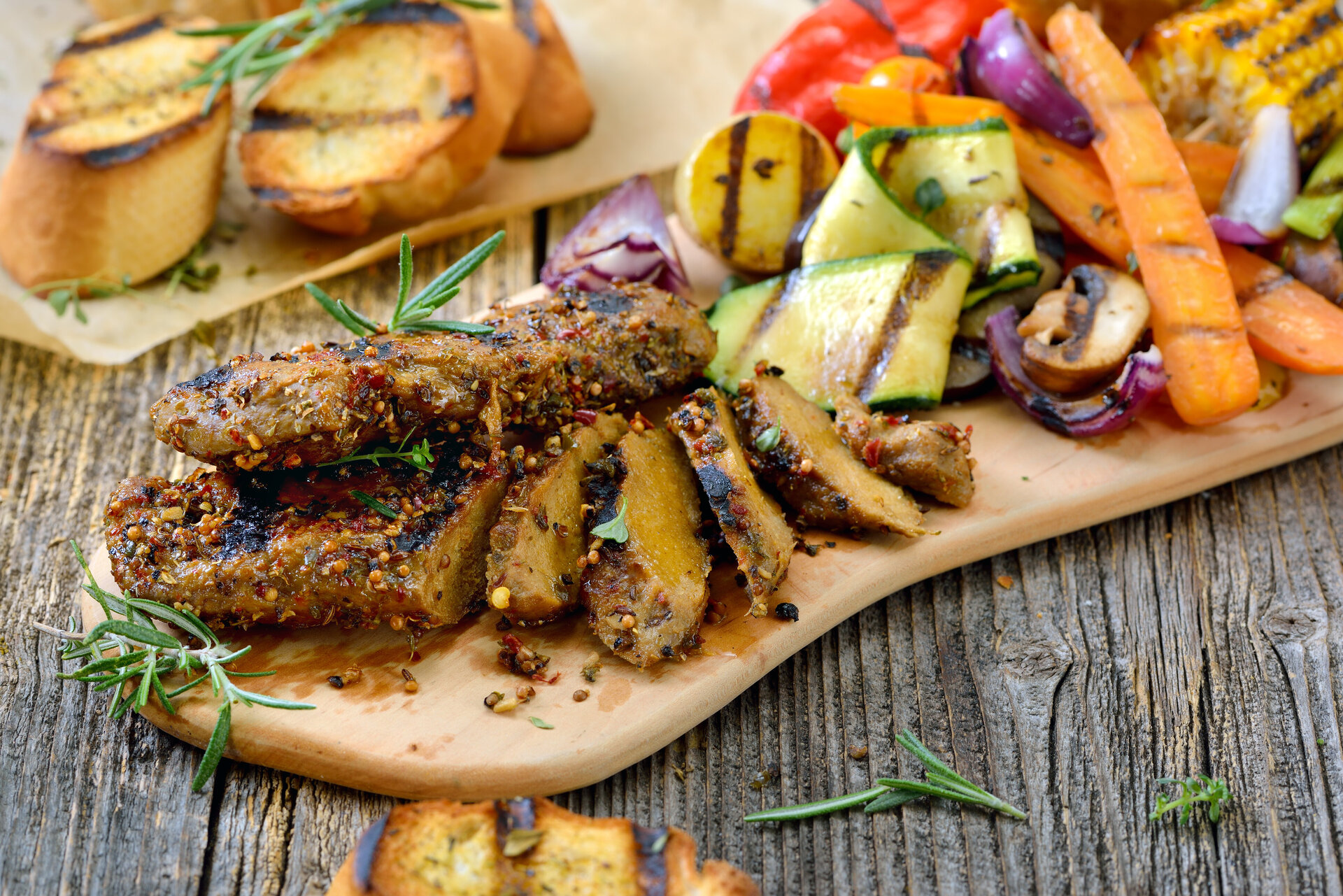
The production of vegetarian and vegan meat alternatives is one of the most challenging tasks in modern food production. This is because consumers have long expected plant-based burgers, vegan mince, meat substitutes for sausages and other plant-based products to offer more than simply the absence of animal-derived ingredients.

Taste, smell, colour, texture and mouthfeel should be as appealing as possible and remain consistent across different production batches. At the same time, manufacturers must produce cost-effectively, use raw materials efficiently and be able to process a wide variety of recipes in a reproducible manner on industrial production lines.

This means that even the preparation of the raw materials becomes a crucial step in the process.

This is because, before a plant-based product can be shaped, heated, extruded, packaged or otherwise processed, its individual components must first be blended together as uniformly as possible.

Mixing technology for the food industry plays a key role in this process.
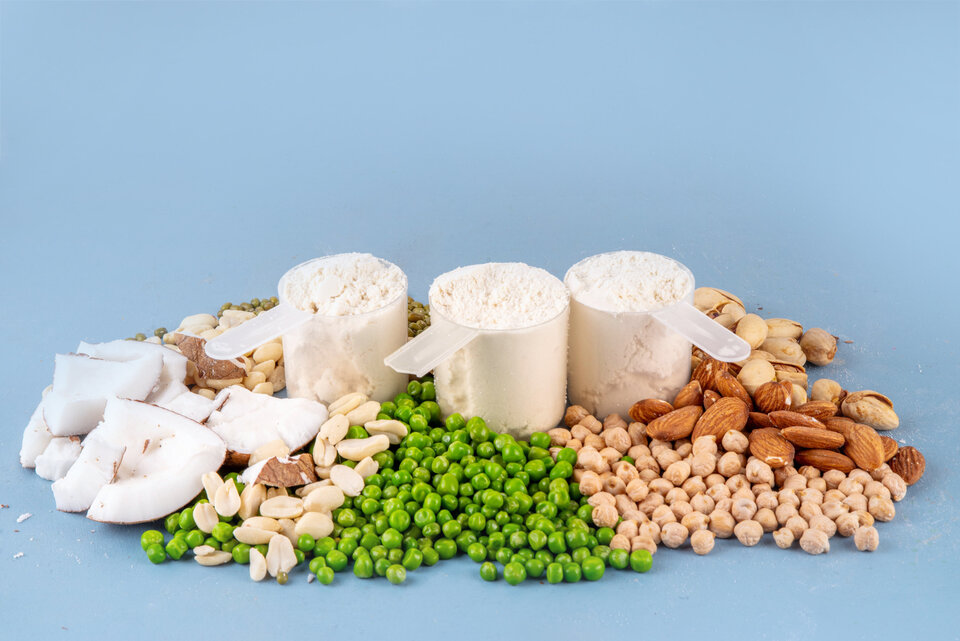
Why the production of meat substitutes is technically challenging

Modern meat alternatives are often complex, multi-component systems. The relevant formulations can consist of more than 30 individual components. These may be dry, semi-solid or liquid, and can vary considerably in terms of density, particle size, rheology and stability.

It is precisely these differences that make industrial processing so challenging.

Depending on the product and formulation, the following groups of raw materials may be used, for example:

  • plant-based protein powders
  • pea protein
  • soya protein
  • wheat protein
  • starch and modified starches
  • plant fibres and dietary fibre
  • spices and spice mixtures
  • natural or synthetic flavourings
  • salt and other crystalline ingredients
  • colourings and colouring food ingredients
  • functional ingredients
  • binders and thickeners
  • oils and fats
  • water
  • emulsions
  • other liquid or paste-like formulation ingredients

The challenge here is not simply to mix these ingredients together in some way. Rather, the aim is to achieve a homogeneous, reproducible mixture that is as gentle on the product as possible.

The quality of the mixing process can subsequently affect numerous properties of the end product.

Plant-based proteins as the basis for modern meat alternatives

Plant-based proteins as the basis for modern meat alternatives

Plant-based proteins are of particular importance. They form the functional basis of the recipe in many meat substitute products.

Depending on the product concept, different protein sources may be considered. In addition to soya and wheat, pea proteins, for example, have gained in importance in many applications. Other pulses and plant-based raw materials can also be used.

In terms of processing, however, these raw materials can differ considerably in some respects.

Powders, for example, can vary in terms of particle size, bulk density, flow properties, moisture content and surface structure.

This is precisely what needs to be taken into account in the industrial mixing process.

A very fine powder behaves differently during mixing to a coarser fibre. A spice, which makes up only a very small proportion of the total mixture, in turn presents different challenges to a protein powder, which forms a significant part of the formulation.

A key function of an industrial mixer for plant-based proteins is therefore to reliably blend a wide variety of components together.

Homogeneity as a key quality factor

In industrial powder blending, homogeneity means that the various components are distributed as evenly as possible throughout the entire batch.

This is particularly relevant in the case of meat alternatives.

Let’s imagine, for example, a dry mix consisting of protein powder, starch, fibre, salt, spices and flavourings. Some of these ingredients make up a large proportion of the recipe, whilst others are present only in small quantities.

Nevertheless, they should be distributed as evenly as possible.

Uneven distribution can result in sub-batches within a batch differing from one another in terms of:

  • taste
  • colour
  • aroma
  • salt content
  • binding properties
  • consistency
  • other functional properties

A high degree of mixing homogeneity in meat substitute products is therefore not merely a technical parameter. It is a prerequisite for ensuring that product quality remains as consistent as possible.

Particle size and bulk density: invisible challenges in powder blending

A common problem in powder processing within the food industry is the variation in particle size and bulk density.

If, for example, a very fine protein powder and a significantly coarser fibre are mixed together, the two components may move differently within the mixing chamber.

Differences in density also play a role.

Heavier particles may behave differently from lighter components. Under unfavourable conditions, this creates a risk of separation or segregation.

The purpose of good mixing technology is therefore not merely to achieve homogeneity at the outset. The mixture should be handled in as controlled a manner as possible throughout the process.

Particularly in the case of complex formulations, the management of product movement within the mixer thus becomes a key process engineering factor.

Spread tiny components evenly

Another challenge is ingredients that are used only in very small quantities.

These include, for example: flavourings, spices, colourings, vitamins, minerals and other functional ingredients.

One kilogramme of such a component may need to be distributed as evenly as possible within a considerably larger total quantity.

The mixing system must therefore reliably account for both main components and smaller ingredients in the formulation.

This can be crucial, particularly in the production of vegan foods, as flavour and sensory perception are often influenced by relatively small quantities of highly potent ingredients.

Flavour and aroma begin right from the blending process

Flavour and aroma begin right from the blending process

The acceptance of a meat alternative is largely determined by its sensory properties.

In particular, shape, consistency, flavour, mouthfeel, texture and smell are key factors in making plant-based alternatives as similar as possible to conventional meat products.

For production, this means that flavour is not simply created during subsequent preparation.

Even the processing of raw materials influences how evenly spices, flavourings and functional ingredients are distributed throughout the product. If, for example, a flavouring accounts for only a small proportion of a recipe, its even distribution throughout the entire mixture is particularly important.

The homogeneous distribution of flavourings and spices is therefore an essential part of quality assurance.

Texture and mouthfeel as key development objectives

One of the biggest challenges with plant-based meat alternatives is texture.

A burger should have a certain bite to it. Vegan mince should be easy to work with and shape. A plant-based sausage, on the other hand, requires different structural properties.

In addition to the actual protein structure, other components also play a role in this.

Fibres can, for example, be used to enhance certain textural properties. Starch, binders and other functional ingredients also influence the final consistency.

This highlights another aspect of modern plant-based food production: it is not just traditional protein powders that need to be processed. Plant-based ingredients with different textures can also form part of complex recipes.

Combining dry and liquid ingredients

Many meat substitute recipes do not consist solely of dry powders.

In addition to protein powders, fibre and spices, they may also contain, for example: oils, water, emulsions or liquid flavourings.

These may form part of the process. This increases the complexity of the process engineering.

A liquid must be distributed as evenly as possible over a large surface area or within a powder mixture. If the liquid is added in an unsuitable manner, areas with high localised moisture content may form.

Depending on the raw materials and the process, this can result in agglomerates or uneven consistencies. For this reason, the addition of liquid during powder mixing is a key consideration when designing the relevant processes.

Agglomeration as an additional process step

However, agglomeration is not necessarily undesirable.

On the contrary: the controlled agglomeration of powders can fulfil a desired process function.

During agglomeration, smaller particles are deliberately combined to form larger structures. This can alter properties such as:

  • flowability
  • dosability
  • handling
  • dust behaviour
  • solubility
  • dispersibility

What is crucial, therefore, is control over the process.

A modern mixer for the food industry can therefore do more than simply blend different powders. Depending on the design and process control, mixing, liquid addition, dispersion and agglomeration can be combined.

Explosion of flavours

Explosion of flavours

Gentle mixing of sensitive raw materials

Not every product benefits from maximum mechanical stress.

Herbs, spices, fibres or other textured ingredients can be sensitive to mechanical stress. At the same time, they must be agitated sufficiently to ensure even distribution.

This creates a conflict of objectives: mixing as intensively as necessary, but as gently as possible.

An efficient mixing process should therefore generate the necessary product movement without introducing unnecessarily high friction or mechanical stress into the process.

Particularly in the case of high-quality ingredients, gentle processing can make a significant contribution to the quality of the end product.

Batch mixing or continuous mixing?

Another fundamental issue in the production of meat alternatives concerns process management. In principle, raw materials can be processed in batches or continuously.

Continuous processes can offer advantages when producing large volumes. However, very complex recipes present additional challenges.

Frequent changes to recipes and an increasing number of individual ingredients can make it difficult to implement continuous mixing processes. One possible solution described here is the batch production of an intermediate component using the majority of the solids.

For manufacturers with: numerous recipes, frequent product changes, varying batch sizes or different flavour variants the flexibility of a batch process can therefore be of particular interest.

Product changeovers and hygiene are becoming a factor in productivity

In the food industry, the assessment of a mixing system does not end with the actual mixing quality.

The time between two batches is also a crucial factor.

If, for example, a manufacturer first produces a strongly seasoned burger recipe and then a product with a significantly milder flavour, residues from the previous production run must be reliably removed.

In addition, there are requirements relating to:

  • food hygiene
  • allergen management
  • the prevention of cross-contamination
  • cleanability
  • plant availability
  • documentable processes

This means that the design of the mixer itself becomes a key factor.

Smooth surfaces, good accessibility, minimal residual quantities and as few hard-to-reach areas as possible can make cleaning considerably easier. Hygienic design in the food industry is therefore not just a question of cleanliness, but also of cost-effectiveness.

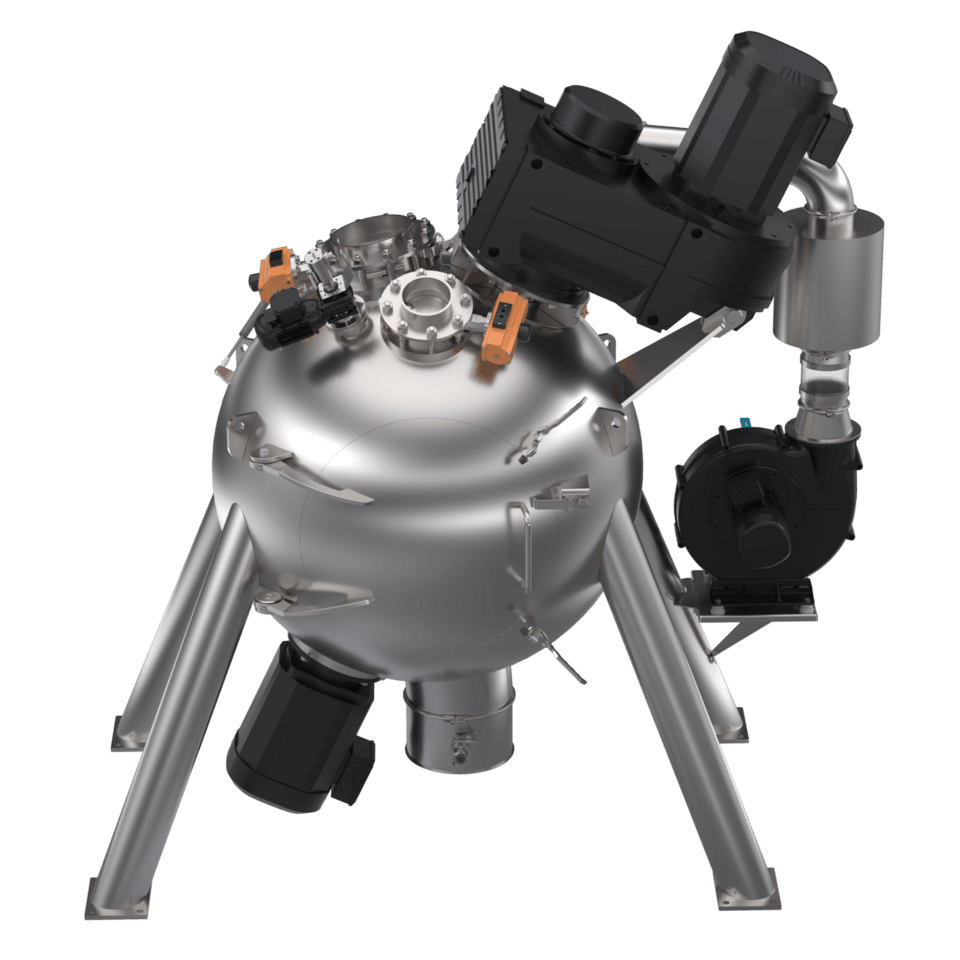
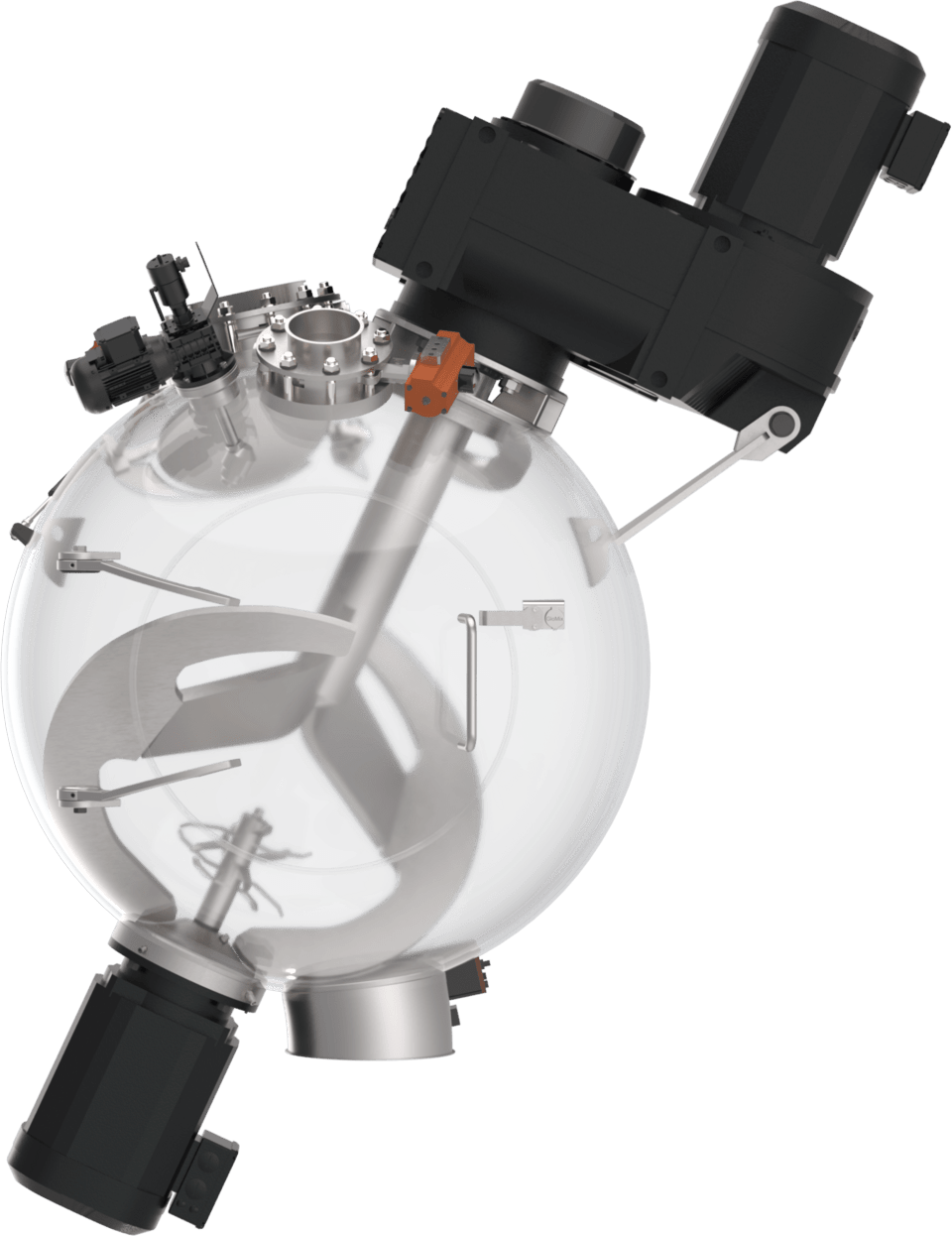
Der GloMix Mischer mit zwei gegenüberliegenden Antrieben auf einer Achse. Oben befindet sich der Hauptantrieb, unten der Schneidrotor.

Residue removal and raw material losses

Another point is often underestimated: what happens to the finished mixture once the mixing process is complete?

The more product remains in the mixer, the greater the losses are likely to be.

In the case of expensive protein powders, flavourings, spices and functional ingredients, even relatively small residual quantities can have a significant economic impact across many production batches.

At the same time, product residues make cleaning more difficult and may be undesirable when switching to a different formulation.

Emptying the mixer as completely as possible therefore serves several purposes at once: higher raw material yield, lower product losses, easier cleaning and quicker product changeovers.

Energy efficiency in food production

In addition to raw material costs, energy consumption and resource efficiency are also becoming increasingly important. When analysing an industrial mixing process, therefore, one should not focus solely on the installed drive power.

Rather, the decisive factor is the interplay between:

Mixing time × energy requirement × batch size × mixing quality achieved

A mixing process that achieves the desired homogeneity in a short time can offer economic advantages over a process that must be run for considerably longer to achieve the same result. This makes energy-efficient mixing technology attractive from both an economic and a resource-related perspective.

From the formula to a reproducible industrial process

A formulation that works in the laboratory does not necessarily translate into a stable industrial production process. During scale-up, numerous parameters must be taken into account:

Raw materials must be dosed reliably. The order in which they are added may be important. Mixing times must be defined. Liquids may need to be introduced in a controlled manner. The discharge process must function correctly. The plant must then be efficiently prepared for the next batch.

The industrial production of meat alternatives is therefore always a combination of food technology and process engineering. This is precisely where choosing the right mixing system comes into play.

Requirements for a modern mixer for meat alternatives

These challenges can be used to derive a set of requirements for modern mixing technology.

An industrial mixer for vegan and vegetarian foods should ideally be capable of processing a variety of raw materials whilst also offering a high degree of process flexibility.

Of particular relevance are:

High mixing uniformity:

It should be possible to distribute both large and small components as evenly as possible.

Processing different consistencies:

Powders, granules and – depending on the process – liquid or paste-like components place different demands on the mixing system.

Liquid addition:

Oils, water, emulsions or flavourings should be able to be incorporated into the process in a controlled manner.

Gentle processing of the product:

Delicate components should not be subjected to unnecessary mechanical stress.

Short mixing times:

Achieving the desired mixing quality quickly increases potential throughput.

Energy efficiency:

The necessary product agitation should be achieved using energy as efficiently as possible.

Effective residual discharge:

Fewer residues mean less product loss and can make subsequent cleaning easier.

Hygienic design:

A mixer suitable for foodstuffs must be easy to clean reliably and as quickly as possible.

Flexibility:

It should be possible to process different recipes and batch sizes as cost-effectively as possible.

When conventional mixing principles reach their limits

Complex food formulations require more than just a conventional mixing process. Different bulk densities, fine powders, structured fibres, micro-ingredients and liquids must be combined in a controlled manner within a single batch. At the same time, short processing times, consistent quality, low energy consumption and quick cleaning are essential.

The Glaxiaris® from GloMix was developed precisely for this purpose.

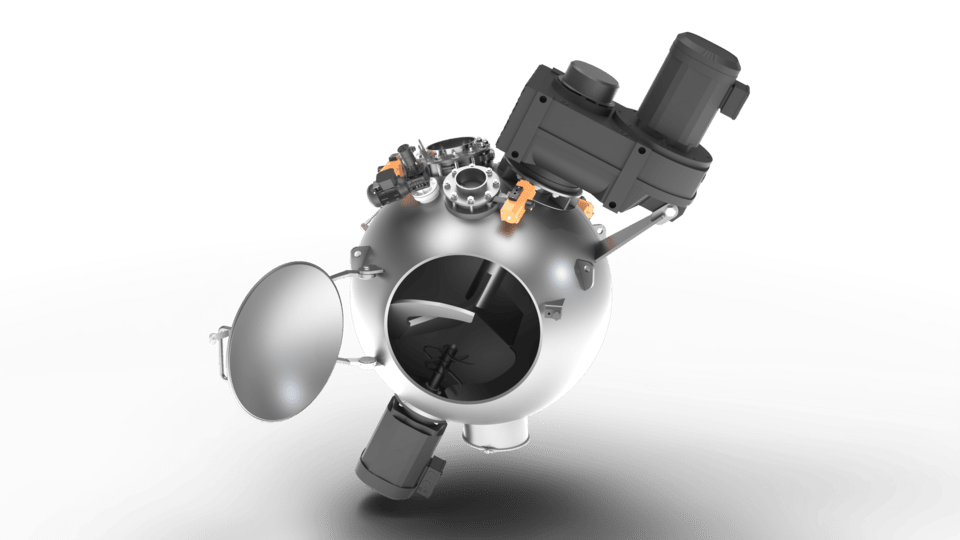
The Glaxiaris® does not follow any conventional horizontal or vertical mixing principle. Its design combines a spherical mixing chamber with a mixing axis inclined at 23°. Together with the mixing tools, this creates a three-dimensional product movement that actively utilises the entire mixing chamber.

The result is not merely a blending of the raw materials, but a controlled, intensive and, at the same time, efficient mixing process.

GloMix offen

The sphere as a logical mixing geometry

The spherical mixing chamber is the central design feature of the Glaxiaris®.

A sphere has a particularly small surface area in relation to its volume. It is precisely this geometric advantage that is utilised in the mixing process: a smaller surface area means less friction between the product and the mixing chamber.

As a result, the product moves efficiently through the mixing chamber, rather than being unnecessarily guided along large wall surfaces.

For the process, this means: less resistance, lower friction, gentler handling of the product and efficient use of the energy input.

This difference is particularly relevant when dealing with sensitive or high-quality raw materials. The aim is not to operate at the highest possible mechanical output, but to achieve the required mixing effect through intelligent product movement.

23° angle of inclination for three-dimensional product movement

The mixing shaft of the Glaxiaris® is deliberately inclined at an angle of 23°. This geometry fundamentally alters the movement of the material being mixed. The product is not moved exclusively horizontally or vertically, but is continuously guided through different sections of the spherical mixing chamber.

Axial, radial and tangential movements are generated. As a result, the product is constantly re-oriented, tumbled and brought into contact with one another. Dead zones are avoided and the entire batch is actively incorporated into the mixing process.

For complex formulations, it is precisely this three-dimensional product movement that is crucial. This is because components with different particle sizes or bulk densities must not only be moved, but also reliably distributed amongst one another.

Two mixing tools. Two mixing streams. A controlled process.

Another key feature of the Glaxiaris® is the two independently adjustable mixing tools mounted on a single axis.

This allows different mechanical tasks to be combined within the mixing chamber. Whilst the main agitator ensures large-scale movement of the batch, an additional tool can be used specifically for more intensive mixing, dispersing or processing tasks.

This provides process flexibility. Instead of processing each formulation with a single, fixed tool movement, the mixing movements can be adapted to the properties of the product.

For food production, this means one thing above all else: greater control over the process.

More than 99% homogeneity

In the case of complex formulations, homogeneity determines whether every sub-batch within a batch possesses the same properties.

The Glaxiaris® achieves a mixing homogeneity of over 99%.

This is particularly relevant when key ingredients and very small quantities are processed within the same formulation. Plant-based proteins, starch, fibres, spices, flavourings or functional ingredients must not simply be added to the mixer; they must subsequently be distributed as evenly as possible throughout the entire batch.

This is precisely where the Glaxiaris®’s three-dimensional product movement comes into its own. A high degree of homogeneity ensures reproducible processes and thus provides a reliable basis for consistent product quality.

Liquids become part of the mixing process

Modern food formulations rarely consist solely of dry ingredients.

Oils, water, emulsions and liquid flavourings are a natural part of the formulation for many products.

The Glaxiaris® integrates these components directly into the mixing process.

Liquids can be introduced into the mixing chamber whilst the mixing process is in progress and distributed immediately throughout the moving product mass.

This takes the process well beyond conventional dry mixing. Protein powders can be combined with oils, dry mixtures can be moistened as required, and spice and flavouring components can be processed with liquids. Similarly, the addition of liquids and agglomeration processes can be combined.

Mixing, dispersing and agglomeration are therefore not regarded as isolated individual processes, but can be integrated within a coordinated system.

A rich blend without unnecessary product build-up

High mixing capacity does not automatically mean high mechanical stress.

Particularly when it comes to foodstuffs, delicate components must be handled with care. Herbs, spices, fibres and other textured raw materials can be damaged by unnecessary friction or intense mechanical stress.

The Glaxiaris® therefore takes a different approach: the required mixing effect is achieved through geometry, product movement and targeted mould action.

The spherical mixing chamber reduces friction surfaces, whilst the inclined axis and the mixing elements move the product in a controlled manner through the mixing chamber. This ensures intensive mixing exactly where it is required – without placing an unnecessary strain on the entire process through excessive mechanical energy.

Energy is converted through a combined effect

Energy efficiency begins with the design of a machine.

In the Glaxiaris®, the mixing chamber, shaft geometry and tool arrangement are designed to utilise the energy input as directly as possible for product movement. The spherical mixing chamber reduces resistance and friction. At the same time, the 23°-inclined axis ensures that the product is actively moved through the entire mixing chamber.

This results in short mixing times and efficient energy utilisation.

This point is particularly crucial in industrial production processes. After all, cost-effectiveness is not achieved solely through a high hourly output, but through the balance between mixing quality, process time and energy consumption.

Product changeover without unnecessary downtime

In flexible food production, recipes change regularly. This means that cleaning becomes a key factor in plant productivity.

The Glaxiaris® is specifically designed to ensure fast and controllable cleaning processes. The system allows for manual dry cleaning as well as, optionally, automated wet cleaning. The smooth surfaces and the easily accessible mixing chamber facilitate rapid product changeovers.

This reduces downtime between batches and simplifies the switch to new formulations. For products with different flavours, colours, allergens or functional ingredients, this flexibility is an essential part of a cost-effective production concept.

Whatever has been mixed in belongs in the product – not in the machine

Whatever has been mixed in belongs in the product – not in the machine

A mixing process is only complete once the batch has left the mixer. That is why the discharge process has also been systematically integrated into the overall design of the Glaxiaris®.

The inclined mixing chamber facilitates rapid and largely complete discharge. Product residues are minimised.

This has immediate benefits: less product loss, reduced cleaning requirements and less carry-over into the next batch.

Particularly when it comes to high-quality proteins, spices, flavourings or functional ingredients, every fraction of the product that can actually be processed further counts.

Designed for flexible production environments

The Glaxiaris® is not designed for a single production scale or a single product category. The system is available in various sizes and thus covers applications ranging from smaller batches right through to industrial production volumes. This is particularly relevant for new product categories.

Many plant-based products start out with smaller production volumes. As market success grows, the need for larger batches and higher production outputs subsequently increases. Scalable mixing technology makes it possible to further develop processes across different production stages.

GloMix Glaxiaris® for plant-based and meat alternatives

The production of plant-based meat alternatives brings together almost all the challenges of modern mixing technology: different protein powders, fibres, starch, spices, minute ingredients and liquids are combined within the mixing process.

Kontaktformular