
Mixing technology encompasses a wide range of process engineering techniques aimed at producing homogeneous material systems with defined properties. Wetting plays a central role in this, as it is often the first and decisive step in the entire mixing process. Particularly when processing powders, pigments, granules or other solids, the quality of wetting has a decisive influence on the subsequent course of the process and the quality of the end product. Inadequate wetting can lead to the formation of agglomerates, prolong mixing times and prevent the desired homogeneity from being achieved. For this reason, wetting is of great technical and economic importance in almost all areas of process engineering.

Powder explosion in blue
Definition of wetting
Wetting refers to the process by which a liquid completely covers the surface of a solid or another liquid. The aim of this process is to maximise the interface between the two phases and to establish intensive contact between them. Only when all particle surfaces are completely covered by the liquid can subsequent process steps, such as dispersion or homogenisation, be carried out efficiently. Wetting thus forms the basis for uniform distribution of the material within a mixing system.
Fundamentals of Physics
Wetting behaviour is influenced by various physical properties. The surface tension of the liquid plays a decisive role in this. Liquids with low surface tension can spread more easily over a solid surface and cover it completely. Similarly, the surface energy of the solid influences wettability. Materials with high surface energy are generally wetted more readily than those with low surface energy. The contact angle is frequently used to assess wetting behaviour. It describes the angle between the liquid surface and the solid surface. The smaller this angle, the better the liquid spreads across the surface and the more favourable the wetting. If the contact angle is close to zero degrees, this is referred to as almost complete wetting, whilst large contact angles indicate poor wettability.
Effect of process parameters
In addition to material properties, process conditions also have a significant influence on the quality of wetting. These include, amongst other things, the temperature, the viscosity of the liquid, the particle size of the solid, and the mixing energy applied. An increase in temperature, for example, can reduce the viscosity of a liquid and thereby improve wetting. At the same time, suitable mixing tools and sufficiently high shear forces ensure that the liquid can penetrate into gaps more quickly and completely envelop individual particles. In many industrial applications, surfactants or special wetting agents are also used. These reduce the surface tension of the liquid, thereby improving its penetration into fine particle structures.
Relation to dispersion
In mixing technology, wetting is the first step prior to the actual dispersion process. Whilst wetting initially involves coating all particles with liquid, the subsequent dispersion process breaks up any existing agglomerates and ensures the uniform distribution of the individual particles within the medium. Both processes are closely interlinked and influence one another. Inadequate wetting makes dispersion considerably more difficult, as dry or only partially wetted particles can only be separated from one another with a significantly higher energy input. Conversely, complete wetting enables the agglomerates to be broken up efficiently and results in a significantly higher degree of homogeneity in the end product.
Industrial applications
The practical significance of wetting is evident in numerous industrial sectors. In the paints and coatings industry, pigments must be completely wetted by the binder in order to achieve uniform colour distribution, high opacity and long-term stability. In the pharmaceutical industry, wetting forms the basis for the homogeneous distribution of active ingredients within liquid or semi-solid dosage forms. This process also plays an important role in the food industry, for example in the production of powdered drinks, sauces or milk-based drinks, where powdered ingredients must be incorporated into liquids quickly and without clumping. In the building materials industry, on the other hand, the uniform wetting of cement and additive particles determines the course of hydration and thus the subsequent mechanical properties of concrete or mortar.
Wetting via vacuum coating of powders
Vacuum coating of porous powders represents a special form of wetting. This process makes use of the fact that, in their natural state, powders trap large volumes of air within their interstices and pores. When a vacuum is applied, this trapped air expands and escapes from the particle aggregate. This loosens the powder, making the surface of each individual particle fully accessible. Only after degassing is the liquid coating medium added or precisely introduced into the powder, so that it can penetrate deep into the pore structure and evenly coat the particles.
This approach offers several process-related advantages. Removing the entrapped air significantly improves wetting, as the liquid can penetrate directly into the porous structure, ensuring an even coating of all particle surfaces. At the same time, agglomeration is prevented because the particles separate from one another during the evacuation process, thereby reducing the formation of lumps. Furthermore, the vacuum enables precise control of the particle properties. This allows liquid active ingredients, catalysts, ions or other functional components to be introduced into porous powder structures in a controlled manner and with deep penetration.
Vacuum coating is used in numerous industrial sectors. In the pharmaceutical industry, it is used, amongst other things, to ensure the even distribution of active ingredients on porous carrier materials. In the food industry, the process is used, for example, in instant products to efficiently incorporate liquids or flavourings into powders. Vacuum coaters are also used in the animal feed industry, for instance in the production of high-quality fish feed, to embed oils and nutrients deep within the pellets. Further applications can be found in the manufacture of speciality pigments, catalysts and functional powdered materials, where a homogeneous and reproducible coating of the particles is crucial for the product properties.
Importance for process quality
In addition to product quality, wetting also influences the cost-effectiveness of industrial mixing processes. Optimal wetting shortens mixing time, reduces energy consumption and increases process stability. At the same time, it improves the reproducibility of results and helps to minimise scrap and material losses. Modern mixing plants are therefore designed to ensure that all particles are wetted as completely as possible right from the first stage of the process. This is achieved, for example, through specially developed mixing tools, optimised flow paths or the precise metering of the liquid phase.
The essence of wetting
In summary, it can be said that wetting is an indispensable fundamental process within mixing technology. It is a prerequisite for subsequent process steps such as dispersion, homogenisation and emulsification, and has a significant influence on the quality of the end product. The targeted control of material properties and process parameters enables an improvement in wetting behaviour and thus greater process reliability and cost-effectiveness. Owing to its fundamental importance, wetting ranks among the most important physical processes in modern mixing and process engineering and is of central relevance in almost all industrial applications.
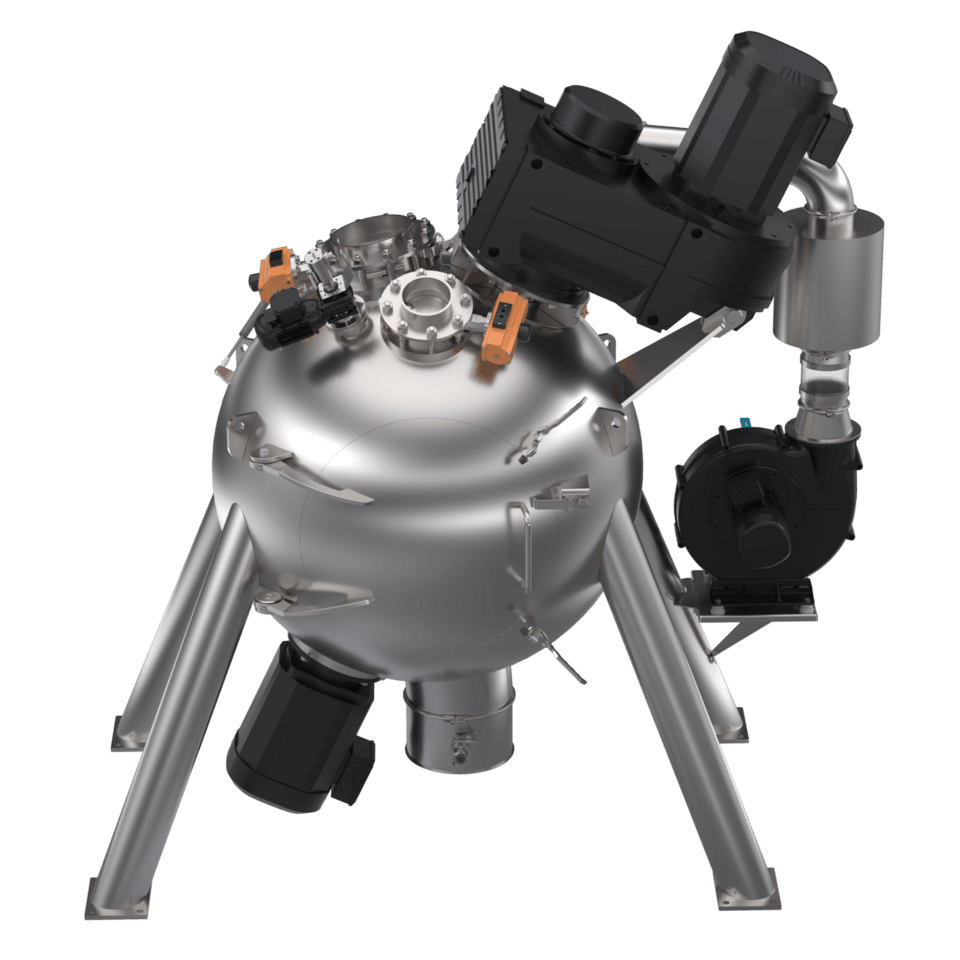
Wetting with GloMix Glaxiaris®
The GloMix Glaxiaris® is specifically designed to create optimal conditions for the rapid and uniform wetting of a wide variety of materials. Thanks to its high-performance mixing technology, the system generates intense flow around the material being mixed, enabling liquids to penetrate powder and bulk material structures efficiently. This reduces the formation of lumps and improves the uptake of the liquid by the particle surfaces. This uniform wetting forms the basis for subsequent effective dispersion and homogenisation. This helps to shorten mixing times, optimise energy consumption and achieve a high degree of reproducibility in process results. Particularly in demanding applications within the chemical, food, pharmaceutical and construction materials industries, the GloMix Glaxiaris® helps to ensure consistently high product quality and efficient process control.