

Bowls of grains, pulses and seeds seen from above

Faster Product Changeovers as a Factor in Profitability

Cleaning, Discharging, Downtime, and Flexible Small-Batch Production Technical report by GloMix GmbH for contract manufacturers, food producers, and companies with frequently changing recipes.

In industrial production, it is not just the actual mixing time that determines a plant’s cost-effectiveness. Especially with small batches, a wide variety of products, and frequent recipe changes, the time between two productive batches becomes significantly more important.

Discharging, cleaning, inspection, and re-approval for production can take up a considerable portion of the available production time. The more frequently a product change occurs, the greater the impact these downtime periods have on plant availability, production capacity, and cost per batch.

For contract manufacturers, contract mixers, and companies in the food industry, one question is therefore becoming increasingly important: How quickly can a mixing system switch from Product A to Product B and resume producing marketable goods? A fast product change thus becomes a key factor in the economic efficiency of industrial mixing processes.
Product Changes as a Cost Factor

When evaluating industrial mixers, the focus is often on throughput, mixing time, drive power, batch size, and mixing quality. However, this approach is not sufficient to determine a system’s actual productivity.

Depending on the application, a batch is followed by additional steps: emptying residual material, opening the system, dry or wet cleaning, inspection, retooling if necessary, and finally approval for the next product. No saleable goods are produced during this time.

With large production volumes and long production runs, these downtime periods are less significant. With small batches and frequently changing formulations, however, they can account for a considerable portion of the available production time. Therefore, when calculating the economic viability of an industrial mixer, the question should not be limited to how quickly a single batch is mixed. Rather, the decisive factor is how many saleable batches can actually be produced within a single shift.

Small batches make quick changeover times even more important

This relationship is particularly evident in contract manufacturing. Different customers, formulations, and raw materials often result in smaller batch sizes and numerous product changeovers.

Suppose that producing a batch—including filling, mixing, and discharge—takes 30 minutes. If the subsequent product changeover takes another 30 minutes, the equipment is only half available for actual production during that time. If the changeover time can be reduced to 15 minutes, for example, profitability improves significantly. Over the course of an entire workday, even a few minutes saved per batch change add up to additional available production capacity.

Flexible production of small batches therefore depends not only on mixer volume and mixing capacity. The speed of the entire batch and product changeover also becomes an important performance metric.

Residue removal affects cleaning and product yield

A key factor in rapid product changeovers is ensuring that the mixer is emptied as thoroughly as possible.

After discharge, product residues may remain on the vessel walls, mixing tools, discharge mechanisms, or in hard-to-reach areas. These residual amounts not only result in product losses but also increase the effort required for subsequent equipment cleaning. A mixing system designed for efficient emptying therefore creates more favorable conditions for the next process step.

The remaining residue can be economically significant, especially when dealing with high-value raw materials and small batches. Small losses per batch can add up to considerable quantities over the course of numerous production cycles throughout the year. Residual emptying, product yield, and cleaning time should therefore not be considered in isolation from one another.

Easy-to-clean design reduces downtime

Easy-to-clean design reduces downtime

The time required to clean a mixer depends not only on the product being processed but also, to a large extent, on the design of the system.

Areas that come into contact with the product should be easily accessible for the intended cleaning procedure. Hard-to-reach areas, unnecessary dead spaces, or spots where material accumulates can increase the effort required for cleaning.

For a mixing system designed for frequent product changes, the following points, among others, are therefore relevant:

  • good accessibility of areas in contact with the produc
  • minimal residual produc
  • easy cleaning of the mixing chambe
  • as few hard-to-reach areas as possibl
  • quick access for inspection and cleanin
  • efficient dry or wet cleaning

In food production in particular, there are additional high requirements for hygiene and product safety. When dealing with different allergens, flavors, colors, or formulations, the risk of unwanted product carryover must also be taken into account.

The goal is therefore not simply the shortest possible cleaning time, but rather a fast, safe, and reproducible cleaning process that is tailored to the product and process.

The total time per batch is the deciding factor

For an economic evaluation, the entire production cycle should be considered:

Filling + Mixing + Discharge + Residual Emptying + Cleaning + Inspection + Changeover = Total time per production cycle

This can lead to a result that may seem surprising at first when product changes are frequent.

A mixer with a ten-minute mixing time followed by 30 minutes of cleaning and changeover can be less productive in actual production than a system with a twelve-minute mixing time that is ready for the next recipe after just another 15 minutes.

The shortest pure mixing time is therefore not necessarily synonymous with the highest economic efficiency. What matters most is the system’s effective availability.

Downtime adds up

The economic potential of short product changeovers can be illustrated with a simple model calculation. For example, if a company performs eight product changeovers per workday and can save ten minutes per changeover, this results in 80 minutes of additional available equipment time each day.

Based on 220 production days, this amounts to approximately 293 additional equipment hours per year. Whether this time can be fully utilized for additional production naturally depends on the order situation, staffing, and upstream and downstream processes. However, the calculation illustrates the impact that regularly recurring downtime can have.

Reducing downtime, optimizing setup times, and shortening cleaning times are therefore not merely organizational issues but can directly influence the profitability of production.

Particularly relevant for contract manufacturers and food producers

For contract manufacturers and contract blenders, production flexibility is part of the business model. It must be possible to process different customer orders, recipes, and batch sizes economically on the same line.

The same is increasingly true for the food industry. Different flavors, seasonal products, private labels, recipe variations, and customer-specific blends increase the number of necessary product changeovers.

A flexible mixing system should therefore not only achieve high mixing quality; it should also process small batches cost-effectively and then be ready for the next recipe as quickly as possible.

This creates an additional approach to increasing capacity: production capacity does not have to be created exclusively through larger systems or additional production lines. Reducing unproductive downtime can also make better use of existing capacity.

Total Cost of Ownership Instead of Just the Purchase Price

When selecting an industrial mixer, therefore, one should not consider only the purchase price.

Factors such as energy consumption, labor costs, maintenance, product losses, cleaning costs, and downtime all play a role in the Total Cost of Ownership (TCO) over the equipment’s service life.

In cases of frequent product changes, recurring cleaning and downtime in particular can have a significant impact on these total costs. A cost-effective equipment decision should therefore always take into account how much marketable product can be produced with the equipment under realistic production conditions.

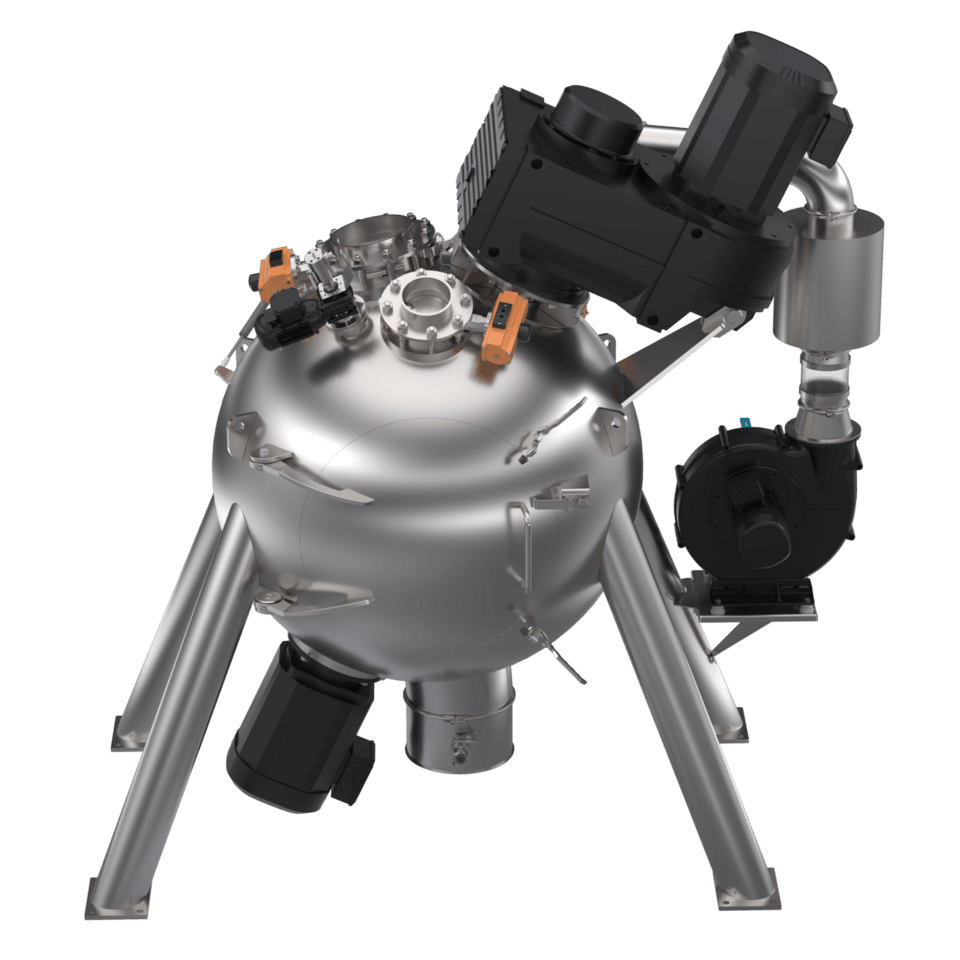
GloMix GLM 1300 mixer with CIP nozzle, block flanges and drying system

GloMix Glaxiaris®: Designed for Flexible Production Processes

This is precisely where the design concept of the GloMix Glaxiaris® ball mixer comes into play.

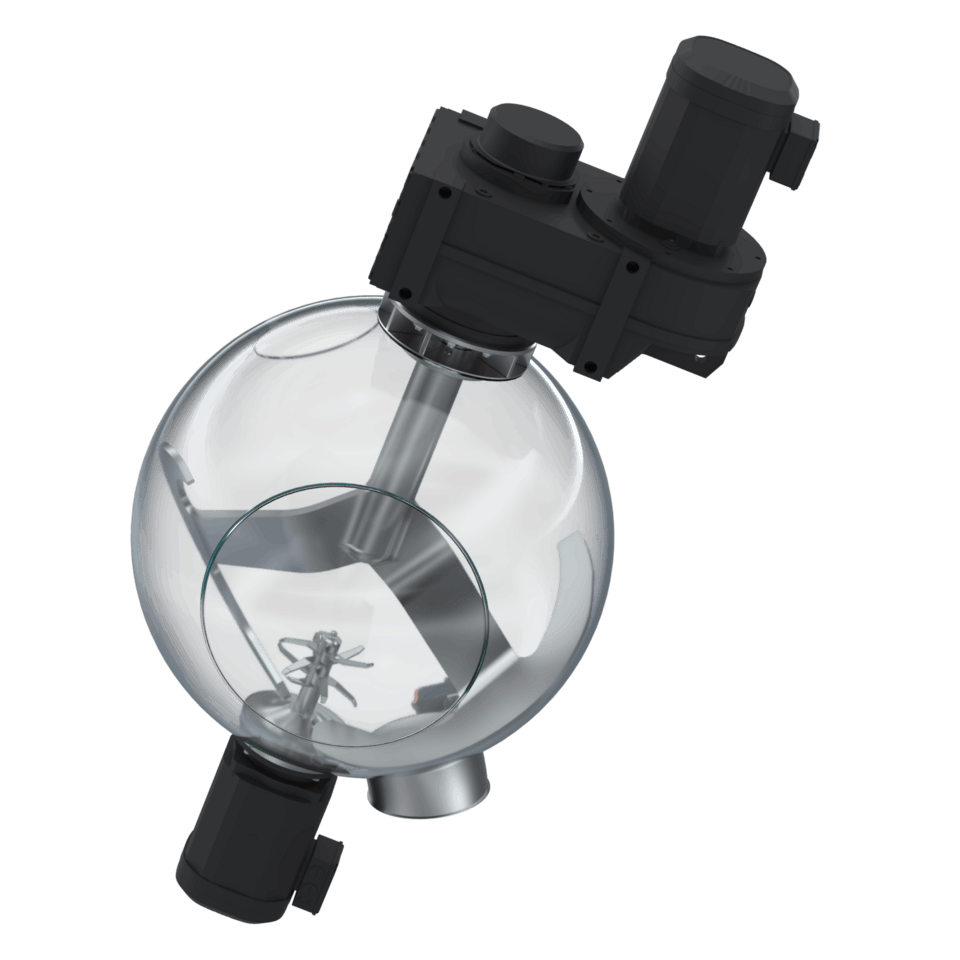
The Glaxiaris® combines a spherical mixing chamber with a mixing axis inclined at 23 degrees. Two independently controllable mixing tools are mounted on a single axis and generate different mixing flows. The design thus combines the characteristics of horizontal and vertical mixing systems.

The design of the mixing chamber is particularly advantageous for applications involving frequent product changes. According to GloMix, the Glaxiaris® is designed for rapid and complete discharge. The inclined geometry aids discharge, while smooth surfaces and easy access to product-contact areas are intended to facilitate subsequent cleaning.

Depending on the application, either manual dry cleaning or automated wet cleaning is possible. GloMix explicitly describes the system as designed for easy product changes, short downtime, and predictable cleaning processes.

Another advantage for flexible production models is the ability to process varying fill volumes. The Glaxiaris® uses an additional mixing tool that aids product movement, particularly at low fill levels. This allows the system design to be adapted to production environments with varying batch sizes.

For contract manufacturers, food producers, and companies with frequently changing recipes, this provides a comprehensive solution: The focus is not solely on short mixing times, but on the combination of efficient mixing, rapid discharge, easy cleanability, and quick product changeovers.

Conclusion

When dealing with small batches and a wide variety of products, mixing time alone does not determine a system’s cost-effectiveness. Residual discharge, cleaning, inspection, and product changeovers also play a role in determining when the next saleable batch can be produced.

For contract manufacturers and food producers in particular, it is therefore worthwhile to consider the total process time when selecting an industrial mixer.

The GloMix Glaxiaris® addresses these requirements through its design: a spherical mixing chamber, an inclined mixing axis, efficient discharge, and a design optimized for rapid dry or wet cleaning combine mixing technology and product changeover into a single, integrated process. After all, what ultimately determines cost-effectiveness is not just how fast a mixer mixes—but how quickly it is ready for the next saleable batch.

Kontakt