
Geometry in industrial mixing

Why geometry is crucial in industrial mixing: the influence of ball shape, surface area and mixing chamber geometry on product movement, friction, mixing time and mixing quality.

Geometry in industrial mixing

In industrial mixing technology, it is not only the speed, motor power and mixing tools that determine the quality of a mixing process. One key factor is often underestimated: the geometry of the mixing chamber.

Whether it is a powder mixer, solids mixer, batch mixer, granulate mixer or industrial mixer – the shape of the mixing vessel influences how raw materials move within the mixing chamber, what friction conditions arise and how quickly a defined mixing quality and homogeneity can be achieved.

For companies in the fields of process engineering, the food industry, the chemical industry, the pharmaceutical industry, the building materials industry and other process industries, this therefore raises a fundamental question:
How must an industrial mixer be designed to ensure that the product is mixed as efficiently and homogeneously as possible, whilst at the same time being handled gently?

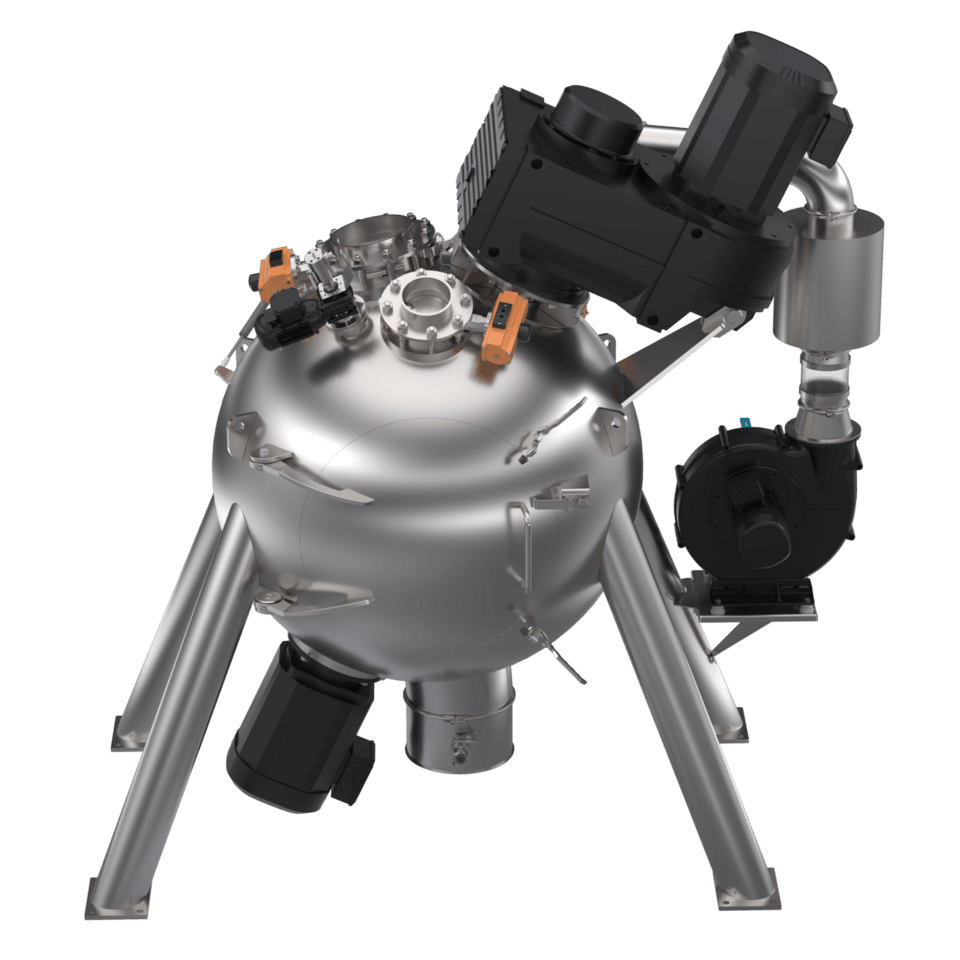
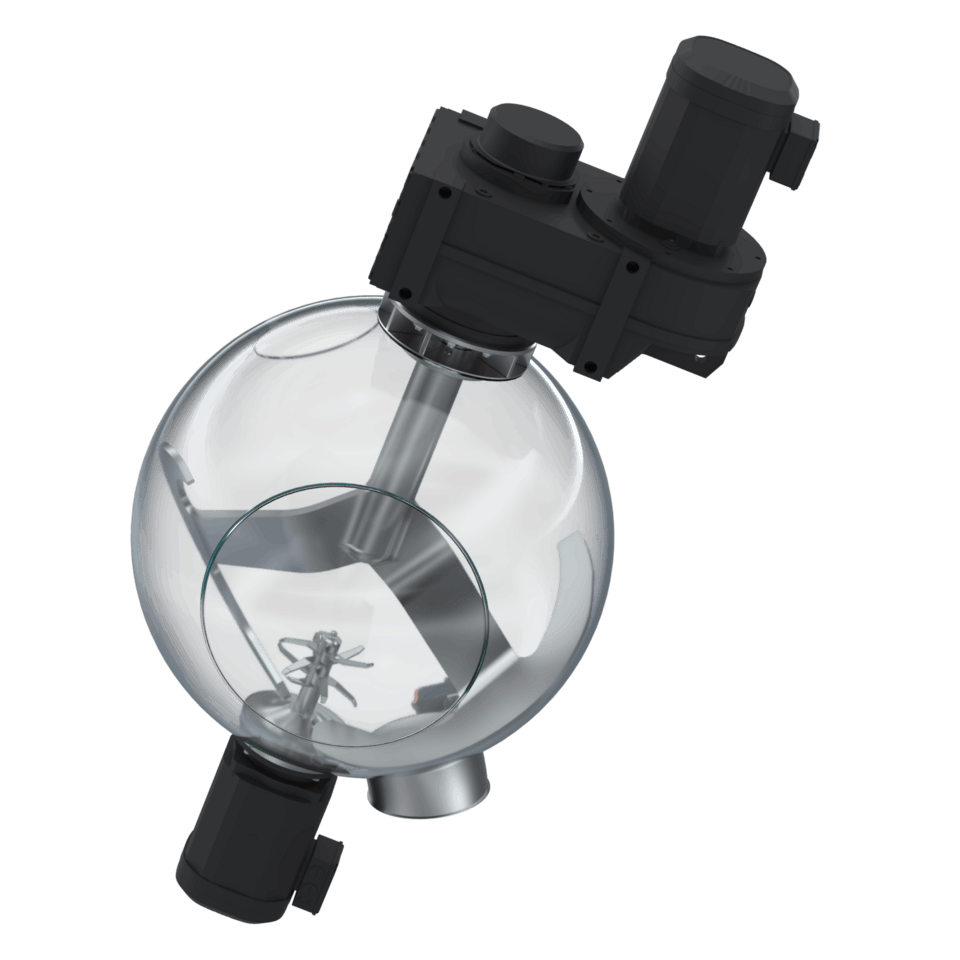
The GloMix Glaxiaris® mixer takes a geometry-based approach to this. A spherical mixing chamber is combined with a mixing axis inclined at 23° and coaxially arranged mixing tools. This creates three-dimensional product movement comprising axial, radial and tangential components.

The geometry itself thus becomes a process engineering tool.
Industrial mixing technology: Why product movement determines mixing quality

An efficient industrial mixing process is not achieved simply by having a mixing tool move at high speed. The key factor is how the entire volume of the product is captured and redistributed within the mixing vessel.

When processing powders, granules, solids, liquids or paste-like products, various mixing mechanisms can work together:

  • convective movement of large quantities of product
  • axial product movement
  • radial product movement
  • tangential product movement
  • relative movement between particles
  • shearing and local rearrangement
  • dispersion and deagglomeration
  • distribution of liquids in solid mixtures

The design of an industrial mixer has a direct influence on the extent to which these mechanisms are evident.

If areas of low product movement develop within the mixing vessel, raw materials must be agitated for longer until the required homogeneity is achieved. This can affect the mixing time, energy consumption and, ultimately, the cost-effectiveness of the entire production process.

When designing industrial mixing systems, the crucial question is therefore not only: How intensively does the mixing tool operate? Equally important is: How does the geometry of the mixing chamber support the movement of the product?

Spherical mixing vessel: Why the sphere is of interest in mixing technology

Spherical mixing vessel: Why the sphere is of interest in mixing technology

The sphere has a particular geometric property: of all solids with the same volume, it has the smallest surface area. This ratio of surface area to volume is of particular interest in industrial mixing technology.

A spherical or near-spherical mixing chamber can provide a comparatively small container surface area for a given volume. This fundamentally reduces the area over which the product interacts with the container wall.

This property can be relevant for various aspects of process engineering:

Product flow: The continuously curved internal contour creates different conditions for product flow than vessels with pronounced corners and transitions.

Friction: The size and design of the surface in contact with the product influence the interaction between the product and the container wall.

Product build-up: Depending on the product properties, the container geometry and surface finish can influence the formation of build-up.

Cleaning: A smaller surface area in contact with the product can reduce the cleaning effort required for a mixing system.

Discharge: A suitable vessel geometry can help ensure that a batch is discharged as completely as possible.

In the GloMix Glaxiaris®, the spherical mixing chamber therefore forms a central component of the overall mixing concept.

Mixing chamber geometry and friction in industrial mixing processes

When mixing powders and solids, the mechanical energy applied must overcome various forms of resistance.

These include, amongst others:

  • internal friction of the bulk material
  • particle-particle friction
  • particle-wall friction
  • resistance at the mixing tool
  • compaction effects
  • product-specific flow properties

Particle size, particle size distribution, moisture content, bulk density, surface roughness and flowability also play an important role in this context. The geometry of an industrial mixer can therefore never be considered in isolation.

In simple terms, the relationship can be illustrated as follows:

Mixing chamber geometry → Product movement → Friction conditions → Energy input → Mixing time → Mixing quality

The aim of efficient mixing technology is to utilise the energy input as effectively as possible to achieve the necessary product movement.


It is important to note that a smaller vessel surface area does not automatically result in a proportionally lower energy consumption. The actual energy requirement depends on the entire system, comprising the product, the mixing tool, the fill level, the rotational speed, the vessel geometry and the process control.

There can be no efficient mixing technology without the interaction between the vessel and the mixing tool

A spherical mixing vessel on its own does not guarantee optimum mixing performance.

The interaction of various components is crucial to the design of an industrial mixer:

Mixing chamber + mixing tool + tool geometry + axis arrangement + rotational speed + fill level + product properties

The Glaxiaris® therefore combines the spherical mixing chamber with a special arrangement of the mixing axis. The axis is inclined by 23°.

This design combines the characteristics of horizontal and vertical mixing systems and, according to GloMix, facilitates three-dimensional product movement comprising axial, radial and tangential components.

This is particularly important for a powder mixer or solids mixer: the material should not merely be moved in the immediate vicinity of the mixing tool. Rather, as large an area as possible of the entire batch must be regularly exchanged and incorporated into the active mixing process.

Three-dimensional product movement in the Glaxiaris® mixer

The combination of a spherical mixing chamber and a mixing axis inclined at 23° alters the spatial movement of the material being mixed.

The product does not move exclusively in a horizontal or vertical plane. Instead, different directions of movement overlap.

GloMix describes the product movement within the Glaxiaris® as a combination of:

axial movement,

radial movement and

tangential movement.

In industrial process engineering, the underlying principle is crucial: different parts of a batch must be mixed together as efficiently as possible in order to reduce local variations in concentration. Three-dimensional product movement can create favourable conditions for this.

This makes it clear that, when designing a high-performance mixer for industrial applications, the mixing vessel and the mixing tool must not be considered in isolation.

The mixing tool generates movement. The geometry of the mixing chamber influences how this movement is channelled through the product volume.

Macro-mixing and micro-mixing: two functions of an industrial mixing system

The Glaxiaris® operates with two coaxially arranged mixing tools, the rotational speeds of which can be controlled independently. This allows different process tasks to be combined within a single mixing vessel.

In macro-mixing, larger quantities of product are transported through the mixing chamber. The aim is to achieve spatial intermixing of different areas of the batch.

In micro-mixing, or local intensive processing, the focus is on smaller areas of the product. Depending on the application, this may involve, for example, breaking up agglomerates or distributing liquids within a solid mixture.

This interplay is particularly important in the industrial mixing of powders, granulates and bulk materials. A high local mixing intensity alone is not sufficient if larger areas of the batch are not sufficiently mixed. Conversely, large-scale redistribution may not be sufficient if intensive dispersion or deagglomeration processes are required at the same time.

How does the geometry of the mixing chamber affect the mixing time?

Mixing time is one of the most important performance and economic efficiency indicators in industrial mixing processes.

What matters is not how long a mixer’s motor runs, but how long the process takes to achieve a defined mixing quality or homogeneity. There is therefore a direct correlation between product movement and mixing time.

If different areas of a batch are exchanged quickly and regularly, the desired distribution can, in principle, be achieved with fewer mixing cycles.

If, on the other hand, individual areas are only slowly integrated into the main flow, they can determine the total mixing time required. For an efficient industrial mixer, therefore, the maximum possible product movement is not the sole objective.

What is crucial is effective product movement throughout the entire mixing volume. To achieve this, the Glaxiaris® combines a spherical mixing chamber geometry, an inclined mixing axis and coaxial mixing tools. GloMix specifies short mixing times and a homogeneity of over 99 per cent for the mixing system. However, the mixing quality and mixing time that can actually be achieved always depend on the product, formulation, fill level and process parameters.

Gentle mixing rather than maximum mechanical stress

A high-performance industrial mixer does not necessarily have to operate at maximum speed or with maximum shear force. For many products, a gentle mixing process is actually required.

This applies, for example, to:

  • delicate powders and granules
  • herbs and leaf products
  • textured foods
  • coated particles
  • temperature-sensitive raw materials
  • mixtures of different particle sizes
  • products containing fragile components

Excessive mechanical stress can cause abrasion, particle breakage, heat build-up or changes to the product structure. Optimised mixing chamber and tool geometry therefore pursues a different objective:

Achieve the required homogeneity with the most targeted energy input possible.

If the design of the mixing vessel and mixing tools facilitates the redistribution of the product, the mixing effect need not be generated solely through high tool speeds or strong local shear forces.

The geometry of a mixer thus also becomes a factor in gentle industrial mixing.

Emptying and cleaning industrial mixers

The cost-effectiveness of a mixing process does not end with the actual mixing operation. After each batch, the product must be discharged from the batch mixer. Depending on the industry, formulation and hygiene protocol, this is followed by cleaning. Here, too, the geometry of the mixing chamber plays a crucial role.

Emptying as completely as possible

Areas that are difficult to access, edges and geometric transitions can lead to residual product build-up.

An optimised vessel geometry, on the other hand, can facilitate the complete emptying of a mixer and reduce product losses.

According to the manufacturer, the Glaxiaris®’s sloped design facilitates rapid and largely complete emptying.

Hygienic design and ease of cleaning

In mixers used in the food, pharmaceutical, chemical and other sensitive production sectors, ease of cleaning plays a particularly important role.

The spherical mixing chamber of the Glaxiaris® features a continuous internal contour. According to GloMix, the system is designed for both manual dry cleaning and, optionally, automated wet cleaning.

The geometry of the mixing chamber therefore influences the entire batch process:

Filling → Mixing → Homogenising → Emptying → Cleaning → Next batch

When carrying out an economic assessment of an industrial mixing system, therefore, one should not focus solely on the mixing time. Rather, the total process and cycle time is the decisive factor.

GloMix GLM 1300 mixer with CIP nozzle, block flanges and drying system

Mixing technology and scale-up: Why geometry remains important even with larger mixers

When scaling up industrial mixing processes, a process is transferred from a smaller to a larger production plant.


This results in changes to the geometric and physical conditions. From a process engineering perspective, a 5,000-litre industrial mixer does not automatically behave in exactly the same way as a small pilot-scale mixer.

As the size increases, the following, amongst other things, change:

  • Surface-to-volume ratio
  • power density
  • tool peripheral speed
  • flow and motion conditions
  • product paths
  • fill volumes and fill levels

The Glaxiaris® retains its fundamental geometric mixing principle across different sizes. According to GloMix, the range includes models from the GLM 60, with a net volume of 50 litres, up to the GLM 6300, with a net volume of 5,000 litres.

However, product-specific mixing trials and process engineering design remain essential for the reliable scale-up of a mixing process. Geometric similarity creates important prerequisites for scale-up – but it is no substitute for process design.

What factors influence an industrial mixing process?

When selecting and designing a powder mixer, solid mixer or batch mixer, numerous factors must be considered together.

The most important of these include:

Mixing chamber geometry: How is the mixing vessel constructed?

Mixing tool geometry: How is mechanical energy transferred to the product?

Product movement: How are raw materials moved axially, radially and tangentially?

Filling level: What proportion of the mixing chamber is actually utilised?

Rotational speed: What tool speed is required for the product?

Mixing time: How quickly is the required mixing quality achieved?

Homogeneity: How evenly are the components distributed after the mixing process?

Product properties: What are the material’s bulk density, particle size, moisture content and flowability?

Product stress: How sensitive are the particles to shear, friction and mechanical stress?

Discharge and cleaning: How quickly can the next batch be started?

It is the interplay of these factors that determines the performance of an industrial mixing plant.

Glaxiaris®: Industrial mixer with a spherical mixing chamber

The GloMix Glaxiaris® is an example of how geometric principles can be specifically integrated into the design of an industrial mixing system.

The concept combines several elements:

Spherical mixing chamber
The sphere offers a favourable surface-to-volume ratio and a continuous internal contour.

Mixing axis inclined at 23°
The unique axis geometry combines the characteristics of horizontal and vertical mixing systems.

Coaxial mixing tools
Two independently controllable tools enable a variety of mixing and processing tasks.

Three-dimensional product movement

Axial, radial and tangential components of motion facilitate the processing of different product ranges.

Consequently, the concept is not based solely on high motor power or high tool speed. The geometry itself becomes an integral part of the mixing technology.

Conclusion: Efficient industrial mixing technology starts with the geometry

Whether it is a powder mixer, solid mixer, granulate mixer, batch mixer or universal industrial mixer: the geometry of the mixing chamber has a significant influence on how a product moves within a mixing plant.

It affects product movement, wall contact, friction conditions, mixing time, mixing quality, product stress, ease of discharge and cleanability.

From a geometric point of view, the spherical shape is particularly interesting because it combines a large volume with a minimal surface area. However, this only translates into an advantage for industrial mixing technology when the vessel geometry, mixing tools, shaft arrangement and process parameters are coordinated with one another.

The GloMix Glaxiaris® mixer combines a spherical mixing chamber with an axis inclined at 23°, coaxial mixing blades and three-dimensional product movement.

The design is thus based on a fundamental principle of modern process engineering and industrial mixing technology:

Efficient mixing does not begin with the mixing blades. It begins with the geometry of the mixing chamber.

Mehr erfahren und Mischer entdecken