Protein powder and dietary supplements

Blending technology for protein powders and food supplements – homogeneity, sensitive ingredients, liquid addition and hygiene as key factors in modern production processes

The manufacture of protein powders and food supplements places high demands on industrial mixing technology. Different particle sizes, widely varying bulk densities, sensitive active ingredients and, in some cases, very small dosing quantities must be reliably processed into a homogeneous end product. At the same time, manufacturers expect short mixing times, reproducible results, flexible production options and a hygienic plant design.

Whether it is whey protein, plant-based protein blends, creatine, electrolyte powders or complex vitamin and mineral formulations: the quality of the end product is largely determined by the mixing process. Modern mixing systems must therefore do far more than simply blend powdered raw materials.

Homogeneity – when the smallest quantities make all the difference

One of the greatest challenges in the manufacture of food supplements is the uniform distribution of ingredients with varying dosages. Whilst proteins often form the main component of a formulation, vitamins, trace elements, sweeteners, flavourings or functional additives are sometimes used only in very small quantities.

Added to this are significant differences in the physical properties of the raw materials. Fine powders with a low bulk density behave differently during mixing than coarse-grained, compact or poorly flowing components. These differences can lead to uneven distribution or segregation.

Formulations containing micronutrients are particularly challenging, as even slight deviations in concentration can affect product quality. It is therefore not only the intensity of the mixing action that is crucial, but also controlled product handling, ensuring that as many components as possible are reliably incorporated.

Mixing quality can be assessed, for example, by analysing representative samples and determining the coefficient of variation. For components added in small quantities, a suitable pre-mix may also be advisable. A high-performance mixing system must not only achieve a high degree of homogeneity, but also ensure that this is reproducible across different batch sizes and varying formulations.

Running figure formed from tablets and capsules

Gently processing delicate ingredients

Not every ingredient can withstand intense mechanical stress. In the supplements sector in particular, there is a growing trend towards the use of functional, high-quality raw materials, the properties of which should remain as unchanged as possible during processing.

These include, amongst others, sensitive vitamins, enzymes, probiotic cultures, microencapsulated active ingredients and specialised flavouring components. Depending on the formulation, mechanical stress, temperature changes, moisture or contact with oxygen can compromise the stability of these components. Controlled processing is also important for protein powders. Unnecessarily high mechanical stress can alter the particle structure, create fine particles or affect the flow properties.

Modern mixing technology therefore aims to combine a high standard of mixing with the lowest possible energy input that could damage the product. The nature of the product’s movement is of particular importance here. Uniform, three-dimensional mixing can help to reduce localised stress peaks and distribute sensitive components gently throughout the entire batch.

However, the optimum combination of mixing time, mould rotation speed and fill level must always be tailored to the specific formulation.

Liquid addition – a particular process engineering challenge

Alongside dry powder mixtures, formulations containing liquid additives are becoming increasingly important. Liquid flavourings, vegetable oils, lecithin or functional ingredients are used, for example, to specifically influence the taste, processing properties or composition of a supplement. The uniform incorporation of such liquids into a powder mixture is technically challenging. Uncontrolled addition can lead to localised excess moisture, agglomerates and sticking. Fine or hygroscopic powders, in particular, are sensitive to uneven liquid distribution.

It is therefore crucial that the liquid is introduced in a metered manner into a sufficiently agitated powder bed. Suitable dosing systems and a tailored mixing action support distribution and reduce the risk of unwanted clumping.

In certain applications, however, targeted agglomeration may be expressly desired. For example, the wettability, dust behaviour or handling properties of instant powders can be improved through the controlled addition of liquid and subsequent process steps. This means that the mixer is not only used for homogenisation, but also performs additional process engineering tasks.

Hygiene and ease of cleaning as key quality factors

When processing protein powders and food supplements, the hygienic design of production facilities is of particular importance. Frequent changes to formulations, raw materials containing allergens and highly concentrated ingredients place special demands on the cleaning process. Even small amounts of residue from a previous batch can cause undesirable cross-contamination in subsequent products.

A mixer designed to meet hygiene standards should therefore have as few hard-to-reach areas as possible. Smooth surfaces in contact with the product, good accessibility and a well-thought-out discharge system facilitate cleaning and reduce the effort required between two production batches. Depending on the product and the plant design, different cleaning methods may be suitable. For dry powder products, suitable dry cleaning may be advantageous. For other applications, wet cleaning is recommended, supported where necessary by automated cleaning systems.

Following wet cleaning, it is essential to ensure that products are thoroughly dried, particularly in the case of moisture-sensitive items. Good cleanability is therefore not only a matter of hygiene, but also a key factor in cost-effectiveness. Shorter cleaning and changeover times increase plant availability and facilitate flexible production with frequently changing recipes.

Selection of suitable mixing systems

Various mixing technologies are available for the manufacture of protein powders and food supplements. Their suitability depends largely on the physical properties of the raw materials, the composition of the formulation and the requirements of the product in question.

Whilst some systems are designed for intensive and rapid mixing, others prioritise particularly gentle product handling or flexible batch management.

Mixing system

Typical advantages

To note

Ploughshare or intensive mixer

Rapid mixing, liquid feed, agglomerate processing

Mechanical energy input

Belt mixer

Suitable for a wide range of dry powder mixtures

Discharge, dead spaces and cleanability

Cone-type screw mixer

Gentle mixing of delicate powders

Mixing time and incorporation of liquid

Container mixer

Enclosed product transport, flexible batch handling

Suitability when raw material properties vary significantly

Table 1: Comparison of industrial mixing systems for protein powders and food supplements

There is no single ‘best’ mixing technology. The key factor is the interplay between the formulation, process requirements, plant geometry and operating conditions. Particularly in the case of complex supplement formulations, it makes sense to evaluate the mixing technology using real raw materials and practical mixing trials.

Process reliability and cost-effectiveness working in tandem

In addition to the actual mixing quality, energy efficiency, product losses and plant flexibility are increasingly coming into focus.

A cost-effective mixing process is characterised by achieving the required homogeneity in the shortest possible time and with an appropriate level of energy consumption. At the same time, product adhesion and residual quantities after emptying should be kept to a minimum.

Particularly in the case of high-quality food supplements, even small product losses can have significant economic implications. A high degree of flexibility in handling different batch sizes is also advantageous, as manufacturers often produce different product variants on the same plant.

The selection of a mixing system should therefore always be based on a holistic assessment. In addition to mixing quality and product protection, liquid addition, discharge behaviour, cleanability and energy requirements are important decision-making criteria. Practical mixing trials using original formulations provide a sound basis for this. In doing so, it is important to examine not only the homogeneity of the finished mixture, but also the behaviour of the product throughout the entire mixing and discharge process.


Parameters

Target

Mixing homogeneity

Even distribution of relevant ingredients

Mixing time

Cost-effective, reproducible process duration

Product temperature

Avoiding critical thermal stresses

Fluid distribution

Even wetting without unwanted clumps

Remaining quantity

Emptying as completely as possible

Cleaning effort

Safe and Efficient Product Changeovers

Table 2: Key parameters for evaluating and optimising the mixing process


It is particularly important to assess the entire process chain. Even a homogeneous mixture can segregate again during transport, temporary storage or whilst being filled into containers.

For this reason, in addition to the actual mixing process, the subsequent production stages should also be taken into account. This is the only way to ensure that the desired product quality is maintained right through to the finished packaging.

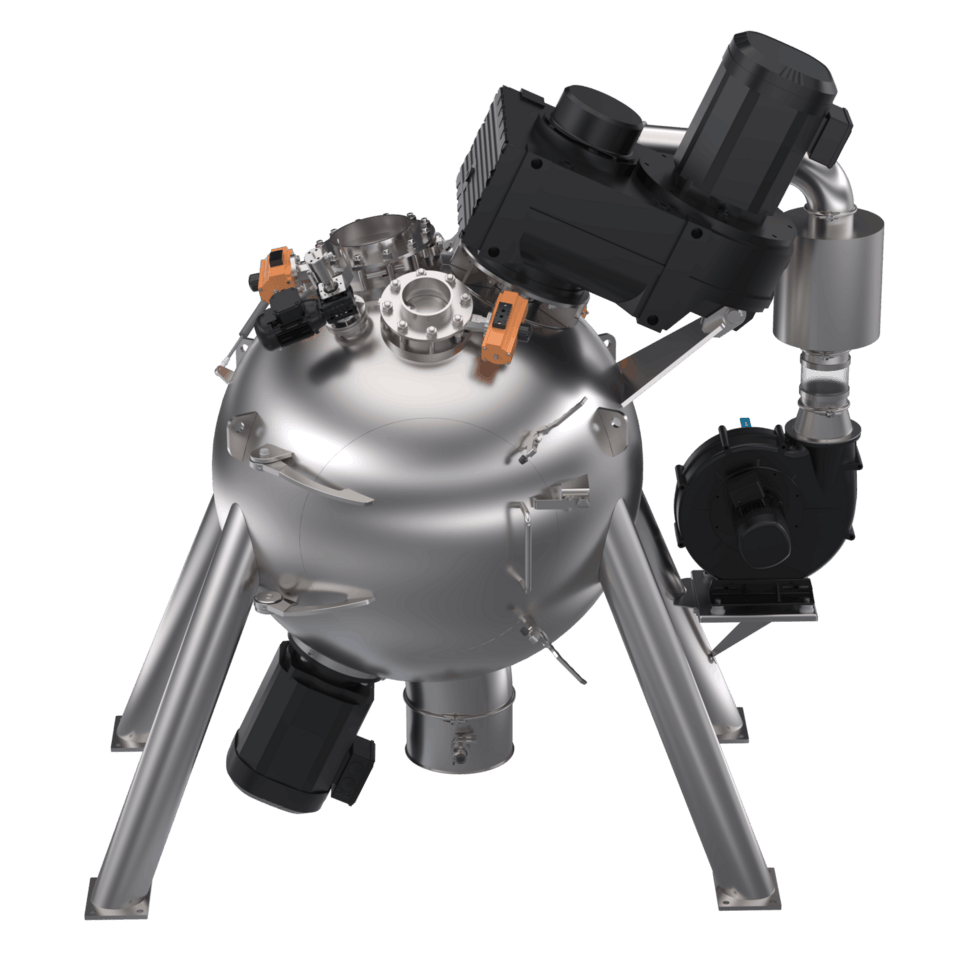
GloMix GLM 1300 mixer with CIP nozzle, block flanges and drying system

Innovative mixing technology: The GloMix Glaxiaris®

The requirements described above highlight that modern supplement production requires a mixing technology that combines homogeneity, gentle processing, flexibility and hygiene.

The GloMix Glaxiaris® employs an innovative design approach. The mixing system combines a spherical mixing chamber with a mixing axis inclined at 23 degrees and two coaxially arranged mixing tools, the rotational speeds of which can be controlled independently of one another.

This design creates three-dimensional product movement with axial, radial and tangential flow components. The mixing principle combines the characteristics of horizontal and vertical mixing systems and enables the targeted movement of raw materials within the mixing chamber. This opens up interesting process engineering possibilities, particularly for protein powders and food supplements.

Homogeneity even with complex formulations: The combination of a spherical mixing chamber and independently controlled mixing tools promotes the even distribution of components with different properties. According to GloMix, a mixing ratio of 1:100,000 was achieved in independently verified mixing trials. The applicability to specific supplement formulations must be verified in the relevant application trial.

Gentle processing of sensitive ingredients: The optimised product flow and the mixing chamber geometry, designed to minimise friction, provide ideal conditions for limiting mechanical stress. This makes the mixing principle particularly suitable for applications where sensitive flavours, active ingredients or particle structures must be taken into account.

Controlled incorporation of liquids: The Glaxiaris® allows liquids to be added during the mixing process. When used in conjunction with a suitable dosing system and an additional comminution tool, liquids can be distributed and agglomerates processed in a targeted manner.

Hygienic design: The spherical mixing chamber, the inspection and discharge hatches designed to minimise dead spaces, and the option of manual dry cleaning or optional automated wet cleaning all facilitate efficient cleaning and rapid product changeovers.

The processing of different batch sizes is also facilitated by the additional mixing tool, which can help to agitate the product, particularly when handling small batch sizes. The GloMix Glaxiaris® thus offers a technically innovative solution for manufacturers who place high demands on mixing quality and product integrity, whilst at the same time seeking to optimise the cost-effectiveness of their production processes.

Conclusion: The right mixing technique is key to product quality

The production of high-quality protein powders and food supplements requires a precisely coordinated interplay between raw material properties, mixing methods and process control. Reliable homogenisation of ingredients added in small quantities, gentle processing of sensitive components, the controlled incorporation of liquids and hygienic plant design form the basis for reproducible product quality.

With its spherical mixing chamber, inclined mixing axis and independently controllable mixing tools, the GloMix Glaxiaris® meets these requirements and opens up new possibilities for efficient and flexible mixing processes.

The most reliable way to determine the benefits that can be achieved with a specific protein or supplement formulation is through practical mixing trials. These allow homogeneity, mixing time, product integrity and cleaning requirements to be assessed under realistic conditions.

GloMix – innovative mixing technology for complex formulations and high-quality products.

Mischer