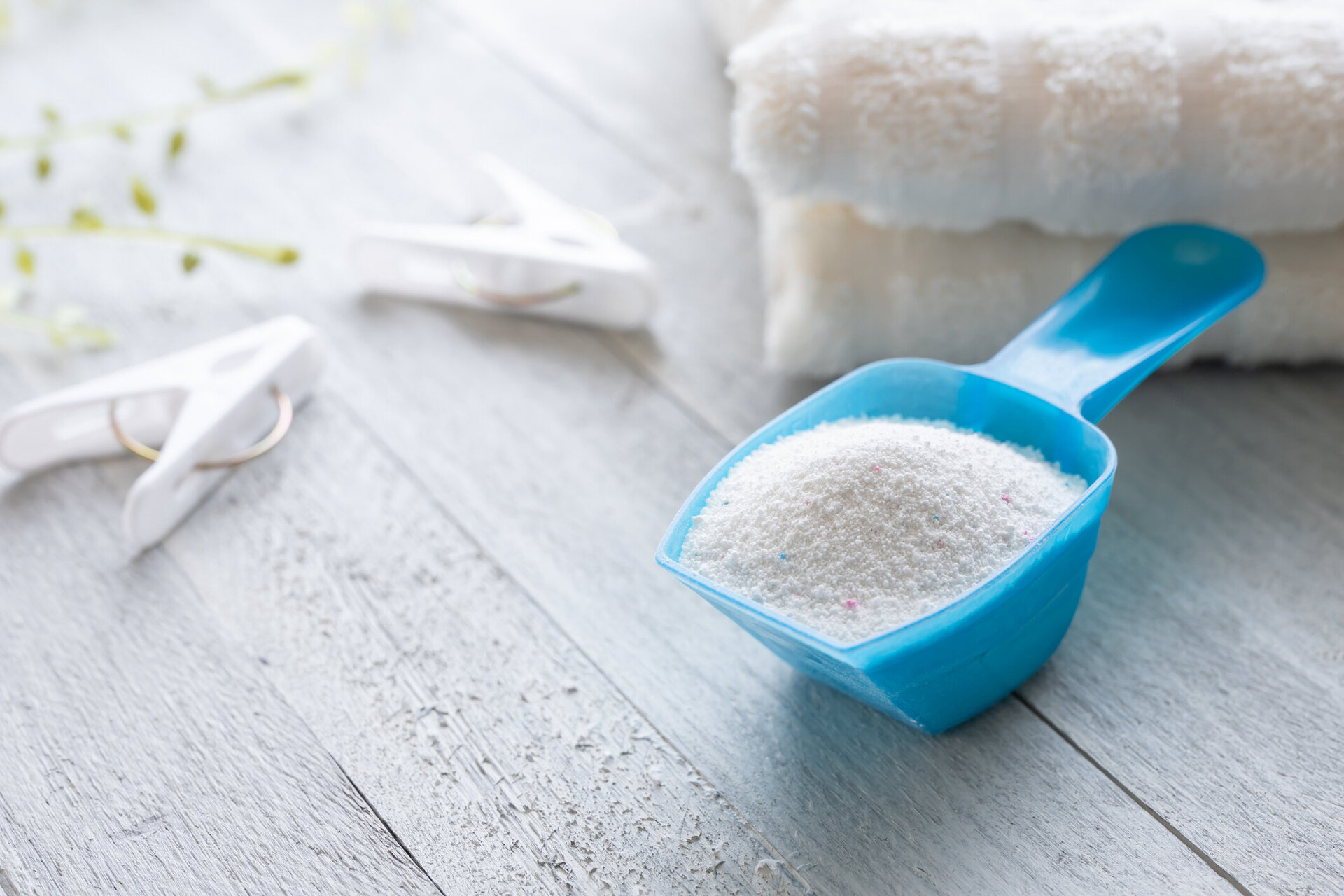
Measuring scoop of milk powder

Washing powder

Manufacture of powdered detergents: mixing technology as a key process for homogeneity, product quality and process efficiency

Powdered detergents are complex, multi-component systems. A single formulation combines raw materials with very different physical properties: fine powders and coarser granules, light and heavy components, highly concentrated trace quantities and, where applicable, liquid constituents. Mixing technology therefore plays a central role in the manufacturing process of powdered detergents.

The aim is not merely to blend different raw materials together. Rather, the industrial mixing process must produce a homogeneous, reproducible powder mixture that is as resistant to segregation as possible. At the same time, the particle structure, flowability, free-flowing properties and ease of dosing of the washing powder must be maintained or specifically adjusted.

Typical constituents of powdered detergents include, amongst others, surfactant components, water softeners or builders, bulking and flow-enhancing salts, stabilisers and functional additives. It is precisely the varying bulk densities, particle sizes and concentrations that place high demands on the homogenisation process.

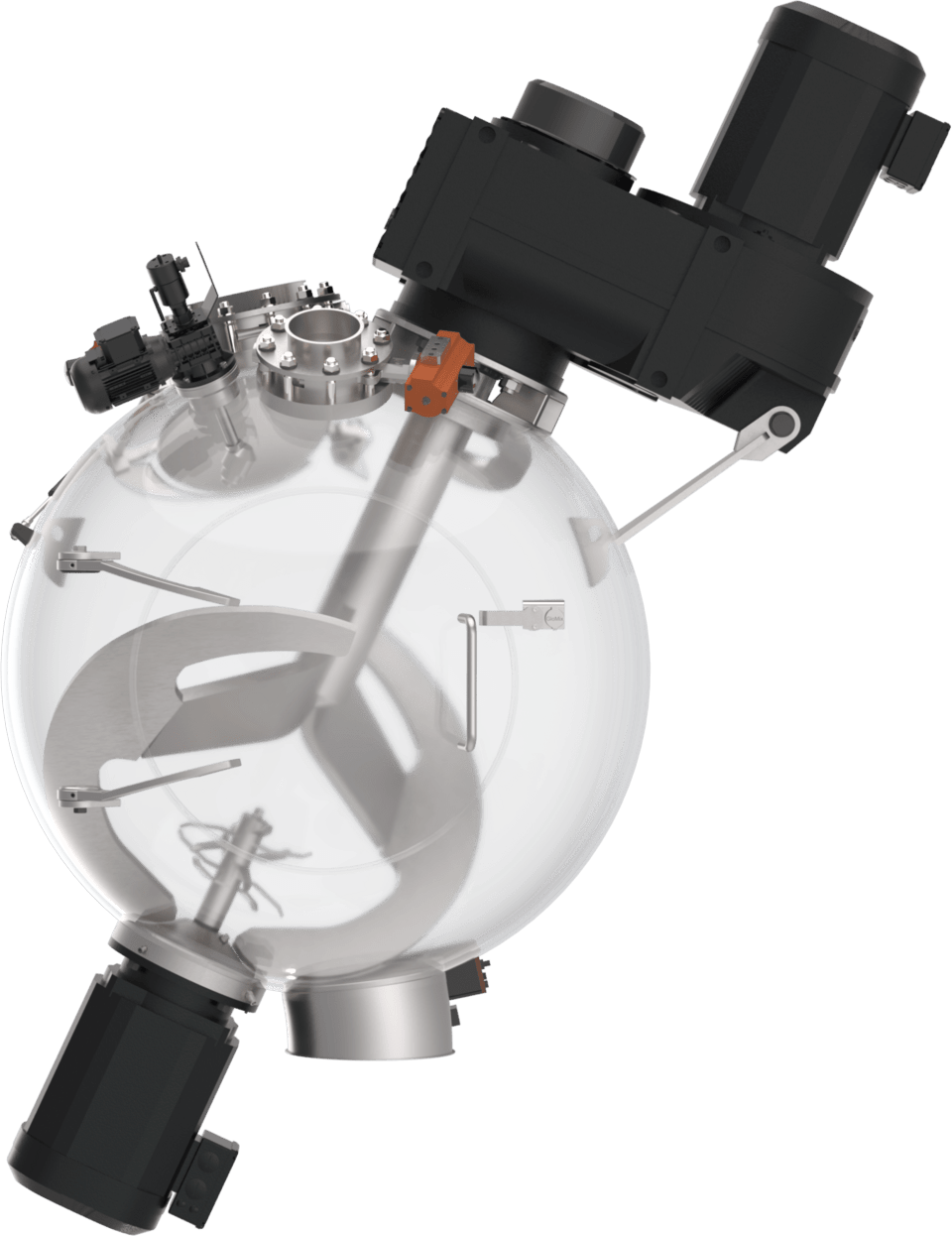
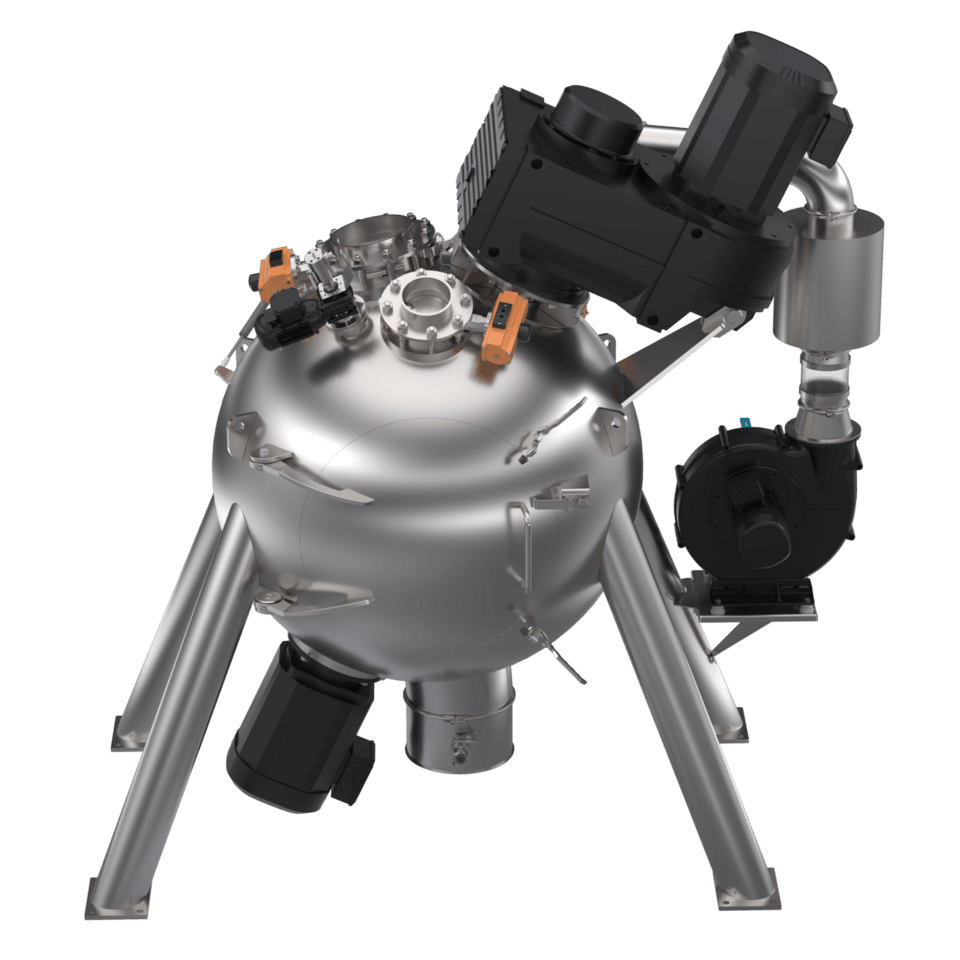
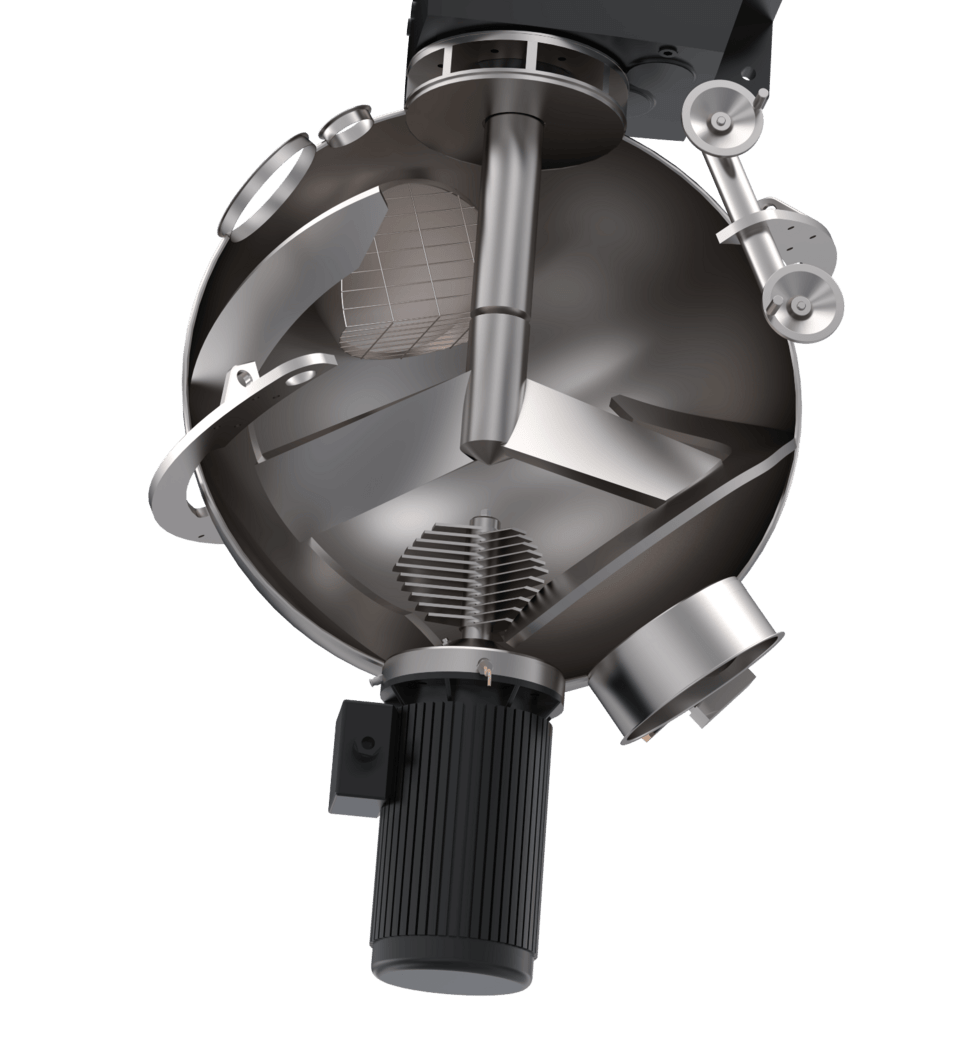
Selecting a suitable industrial mixer is therefore crucial for modern detergent production. The GloMix-Glaxiaris® mixer employs a hybrid mixing principle featuring a spherical mixing chamber, an inclined mixing axis and two independently operating mixing tools. This results in three-dimensional product movement with axial, radial and tangential flow components.
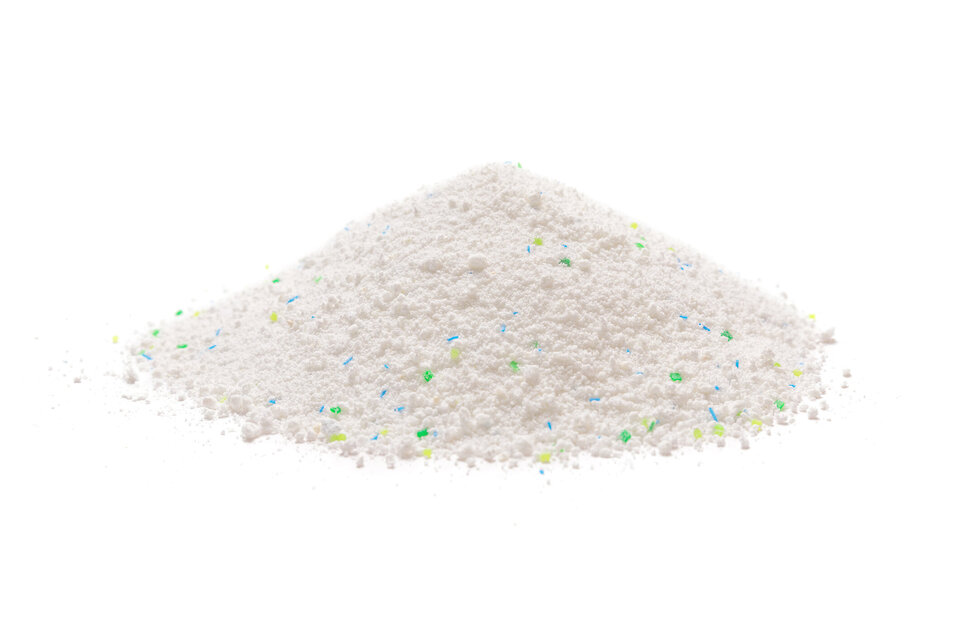
Powder washing detergent: a challenging blending task

Powder washing detergent: a challenging blending task

The production of a powder detergent begins with a formulation in which the individual components must be precisely measured out and then homogenised. The real challenge lies in the heterogeneity of the raw materials used.

Typical formulation components might include, for example:

  • surfactants, or powders or granules containing surfactants
  • builders and water softeners
  • carbonates, silicates and sulphates
  • bleaching agents
  • bleaching activators
  • enzymes
  • polymers
  • optical brighteners
  • fragrances
  • dyes
  • anti-caking agents and release agents
  • functional microcomponents

From a mixing perspective, this results in a complex solid-solid mixing system, which, depending on the formulation, may be supplemented by a solid-liquid mixture.

Significant variations in particle size, particle shape, bulk density, surface texture, moisture content, flow behaviour and concentration present particular challenges. For example, a light powder component may move differently within the mixing chamber than a heavy granulate. At the same time, very fine components must be distributed reliably throughout the entire batch volume.

The primary objective of the mixing process is therefore to produce a homogeneous, reproducible and processing-stable detergent mixture from heterogeneous raw materials within the shortest possible mixing time.

Mixing quality and homogeneity

Mixing quality is one of the most important quality parameters in an industrial powder mixing process. A high degree of homogeneity means that the concentration of a given component varies as little as possible between different samples. This is particularly important in the case of detergents, as localised over- or under-concentrations of functional components can directly affect product quality.

However, a high quality of mixing alone is not enough. It is equally crucial that the homogeneity achieved is maintained after the mixing process. During discharge, conveyance, temporary storage and packaging, powders can segregate again due to differences in particle size and bulk density.

High-performance mixing technology must therefore fulfil several requirements simultaneously: homogenisation – dispersion – deagglomeration – distribution of liquids – agglomeration – gentle handling of the product – minimisation of separation – and ensuring reproducible mixing quality.

Mixing mechanisms in powder detergents

In industrial powder mixers, several mixing mechanisms usually operate simultaneously.

Convective mixing

In convective mixing, larger areas of the product within the mixing chamber are deliberately displaced. Material is transported from one area of the mixing chamber to another. For washing powder, this mechanism is important for quickly achieving a basic homogeneity across the entire batch.

Diffusive mixing

In diffusive mixing, individual particles or small groups of particles change their position relative to one another. This improves the fine distribution. Convective and diffusive mixing processes complement one another: whilst convection enables rapid macroscopic mass transfer, diffusion promotes homogenisation on a smaller scale.

Dispersive mixing

In the case of agglomerates or localised concentrations, a dispersive mixing mechanism is also required. This involves breaking up or dispersing cohesive clusters of particles and subsequently distributing them throughout the mixture. Deagglomeration can be particularly crucial in the case of washing powder, as clumped ingredients can impair the mixing quality, ease of dosing and the visual quality of the product.

GloMix GLM 900 with the mixing chamber open

Three-dimensional product movement in the GloMix-Glaxiaris®

A distinctive feature of the GloMix-Glaxiaris® mixer is the combination of a spherical mixing chamber with a mixing axis inclined at an angle of 23°. According to the manufacturer, the system thus combines the characteristics of horizontal and vertical mixing systems.

The angle of the mixing axis promotes three-dimensional movement of the material being mixed. This results in:

  • axial product movements
  • radial product movements
  • tangential product movements

From a process engineering perspective, this superimposition is of interest for complex powder mixtures. Rather than transporting the mixture primarily along a preferred direction of movement, the aim is for as much of the total product volume as possible to participate continuously in the mixing action. The spherical geometry facilitates a comparatively compact mixing chamber with a small surface area. According to GloMix, this reduces friction and resistance, which is intended to facilitate short mixing times and lower energy consumption.

In the case of powder detergents, this means in particular that components with different particle properties can be thoroughly mixed within the mixing chamber without having to rely solely on high tool speeds.

Two mixing tools on a single axis

Another distinctive feature of the GloMix-Glaxiaris® is its coaxial mixing system. Two mixing tools are mounted on a single shaft, and their rotational speeds can be controlled independently of one another. This allows two different mixing flows to be generated and combined.

The main agitator is responsible for large-scale product movement and homogenisation. An additional, faster-acting tool – such as a cutting rotor or shredder – can be used for more intensive localised processes. The manufacturer specifically cites deagglomeration, coating and the distribution of liquids as relevant functions. This combination opens up a number of process engineering possibilities, particularly in detergent production.

The main agitator carries out the required macro-mixing process, whilst the additional mixing tool can specifically aid micro-mixing, dispersion and deagglomeration. This allows different mixing intensities to be combined within a single unit.

Deagglomeration as a component of mixing technology

Under certain conditions, powders tend to form agglomerates. This can be caused, for example, by moisture, storage, electrostatic effects or liquid components in the formulation.

Agglomerates pose a problem in detergent production if they are not intended to be a specific component of the product structure. They can lead to variations in concentration, difficulties in dosing and an uneven product appearance. A comminution or dispersion tool within the mixer can break up agglomerates whilst the mixing process is underway. The released particles are then redistributed throughout the mixing chamber by the overall product flow.

This results in two interlinked processes: deagglomeration → fine dispersion → homogenisation

The combination of a main agitator and an additional grinding tool is therefore of particular interest for complex detergent formulations.

Mixing in very small components

One of the most challenging tasks in powder mixing technology is the distribution of components with very small mass fractions. If, for example, an additive accounts for only a fraction of the total batch, this material must nevertheless be distributed as evenly as possible throughout the entire mixing volume.

The ratio of the smallest component to the total batch is an important parameter in mixer design.

Rapid three-dimensional product circulation can help to initially distribute micro-components introduced locally over a wide area. Further fine distribution then takes place through repeated redistribution and mixing of the particles.

During process development, the feeding position, feeding sequence, mixing time, mould rotational speed, fill ratio and mixing intensity must therefore be coordinated.

Adding liquid to powder

In addition to dry raw materials, powdered detergents may also contain liquid or pumpable components. This transforms the task of mixing solids alone into a combined solid-liquid mixing task.

The liquid should be distributed as finely and evenly as possible over a large surface area of the solid material. According to the manufacturer, the GloMix-Glaxiaris® allows liquids to be added whilst the mixing process is underway. The combination of product movement and an additional mixing tool is designed to aid the distribution of the liquid.

From a process engineering perspective, it is crucial that the liquid does not simply come into contact with the powder at isolated points. Otherwise, localised over-wetting, adhesion and clumping may occur.

An appropriate process therefore follows this sequence: dosing → wetting → dispersing → distributing → homogenising

Depending on the formulation, the addition of liquid can also be used to achieve targeted agglomeration.

Agglomeration of washing powder

In addition to deagglomeration, controlled agglomeration can also be a desirable process. Fine powders often have undesirable properties in terms of dust generation, flowability or handling. Agglomeration involves the targeted combination of smaller particles to form larger aggregates.

This can, for example, influence the following product properties: free-flowing ability, flow behaviour, dusting behaviour, bulk density, ease of dosing and dispersibility.

According to the manufacturer, the GloMix-Glaxiaris® is designed for mixing and dispersing as well as for agglomeration processes. The ability to introduce liquids whilst the product is in motion fulfils a key process engineering requirement in this regard. This allows a mixing process to go beyond mere homogenisation and, at the same time, to be used as a process step that imparts structure.

Gentle mixing of the product

A high mixing intensity does not automatically equate to high mixing quality.

Excessive mechanical energy input can damage granules, produce an undesirable proportion of fine particles, or subject sensitive components to mechanical stress. The challenge for modern mixing systems is therefore to achieve a high degree of homogenisation whilst maintaining controlled shear stress.

The spherical mixing chamber of the GloMix-Glaxiaris® is designed to reduce friction between the product, the mixing tools and the mixing chamber. Together with the three-dimensional movement of the product, this is intended to facilitate gentle mixing.

This is particularly relevant for detergents when granulated or coated components are already being incorporated into a formulation and their particle structure is to be preserved as far as possible.

Mixing time and energy efficiency

The mixing time has a direct impact on the plant’s capacity.

For a batch mixer, the formula can be simplified as follows: batch throughput = usable batch volume / total cycle time

However, the total cycle time comprises not only the actual mixing time, but also: filling + mixing + addition of liquid +, where applicable, dispersion/agglomeration + emptying + any necessary cleaning.

Optimising mixing technology should therefore not be aimed solely at minimising mixing time. The total process time per batch is the decisive factor. GloMix technology relies on three-dimensional product movement and reduced friction within the spherical mixing chamber. According to the manufacturer, this can reduce both mixing time and energy consumption.

In industrial detergent production, this can lead to a higher number of batches and improved energy efficiency per tonne of blended product.

Emptying residuals and changing products

Once homogenisation is complete, the powder must be removed from the mixing chamber as completely as possible.

Thorough emptying is important for several reasons: it reduces product wastage, shortens cleaning times and minimises the risk of carry-over into the next batch.

Detergent manufacturers, in particular, often produce different formulations on the same production line. Residues from a previous batch can then lead to cross-contamination or quality deviations. With the GloMix-Glaxiaris®, the angled geometry and a discharge flap designed to minimise dead space facilitate product discharge. The manufacturer describes the system as being designed for rapid and, as far as possible, complete discharge.

GloMix Glaxiaris industrial mixer – transparent with 2 drives

Cleaning as part of the mixing process

The cleanability of an industrial mixer should not be considered in isolation from the actual mixing process.

The more frequently recipes are changed, the greater the impact cleaning time has on available production capacity.

Key design considerations include: smooth surfaces, good accessibility, minimal dead spaces, minimal product adhesion, efficient emptying with minimal residue, and the option of both dry and wet cleaning.

The GloMix-Glaxiaris® is designed for both manual dry cleaning and, optionally, automated wet cleaning processes. Its spherical shape and smooth surfaces are intended to simplify cleaning and product changeovers. In dry detergent processes, efficient dry cleaning may be of particular interest, as it avoids the introduction of water into an otherwise dry production area.

Key process parameters in detergent formulation

To ensure reproducible industrial production, mixing processes should not be defined solely in terms of mixing time. Rather, several parameters must be considered together.

The following are particularly relevant:

  • batch size
  • fill level
  • bulk density
  • particle size distribution
  • mixing time
  • speed of the main agitator
  • speed of the additional mixing tool
  • specific energy input
  • order of raw material addition
  • position of raw material addition
  • timing of liquid addition
  • liquid dosing rate
  • degree of agglomeration
  • deagglomeration intensity
  • product temperature
  • residual moisture
  • discharge time
  • residual emptying
  • cleaning time
  • mixing quality or homogeneity

Together, these mixing parameters form the process window for a recipe.

Scale-up and process development

The transfer of a mixing process from small-scale trials to a production mixer is a key aspect of mixer design. Simply transferring the mixing time is usually insufficient. During scale-up, factors such as product volume, geometric ratios, peripheral velocity, energy input and product movement change.

That is why detergent formulations should be tested under conditions that are as realistic as possible.

Of particular interest in this context are: mixing time – mixing quality – fill level – rotational speed – specific energy input – particle stress – fluid distribution – agglomeration – deagglomeration – discharge behaviour

The data obtained from this enables well-founded process optimisation and forms the basis for the design of an industrial mixing plant.

GloMix GLM 1300 mixer with CIP nozzle, block flanges and drying system

The importance of GloMix-Glaxiaris® in the manufacture of powdered detergents

The production of modern washing powder presents precisely the combination of requirements for which flexible mixing technology is essential: widely varying raw materials must be homogenised, minute components distributed, agglomerates controlled, liquids added where necessary, and the finished powder subsequently discharged as completely as possible.

The technical design of the GloMix-Glaxiaris® combines several functions to achieve this: a spherical mixing chamber + a mixing axis inclined at 23° + three-dimensional product flow + two independently controllable mixing tools + deagglomeration + liquid distribution + agglomeration + low-residue discharge + easy cleaning.

From a mixing engineering perspective, a key advantage is that the process does not rely solely on a single mixing mechanism. Rather, convective, diffusive and dispersive processes can be combined and adapted to the specific formulation by varying the tool speeds. The industrial mixer can therefore be regarded as the central piece of process equipment within a detergent production line.

Conclusion

Mixing technology is one of the crucial process steps in the manufacture of powdered detergents. Different bulk densities, particle sizes, concentrations and material properties must be combined within a short time to form a homogeneous and reproducible mixture. At the same time, segregation, agglomeration, dust formation, particle damage and product adhesion must be controlled.

The GloMix-Glaxiaris® mixer offers a specialised mixing concept for this purpose. The spherical mixing chamber, the axis inclined at 23°, the three-dimensional product movement and two independently controllable mixing tools enable the combination of various mixing functions. In addition to conventional powder mixing and homogenisation, processes such as dispersion, deagglomeration, liquid addition and agglomeration can also be incorporated into the process control.

For industrial detergent production, this results in an approach that takes into account mixing quality, mixing time, product protection, energy efficiency, flexibility, complete emptying and ease of cleaning as a whole.

Kontakt