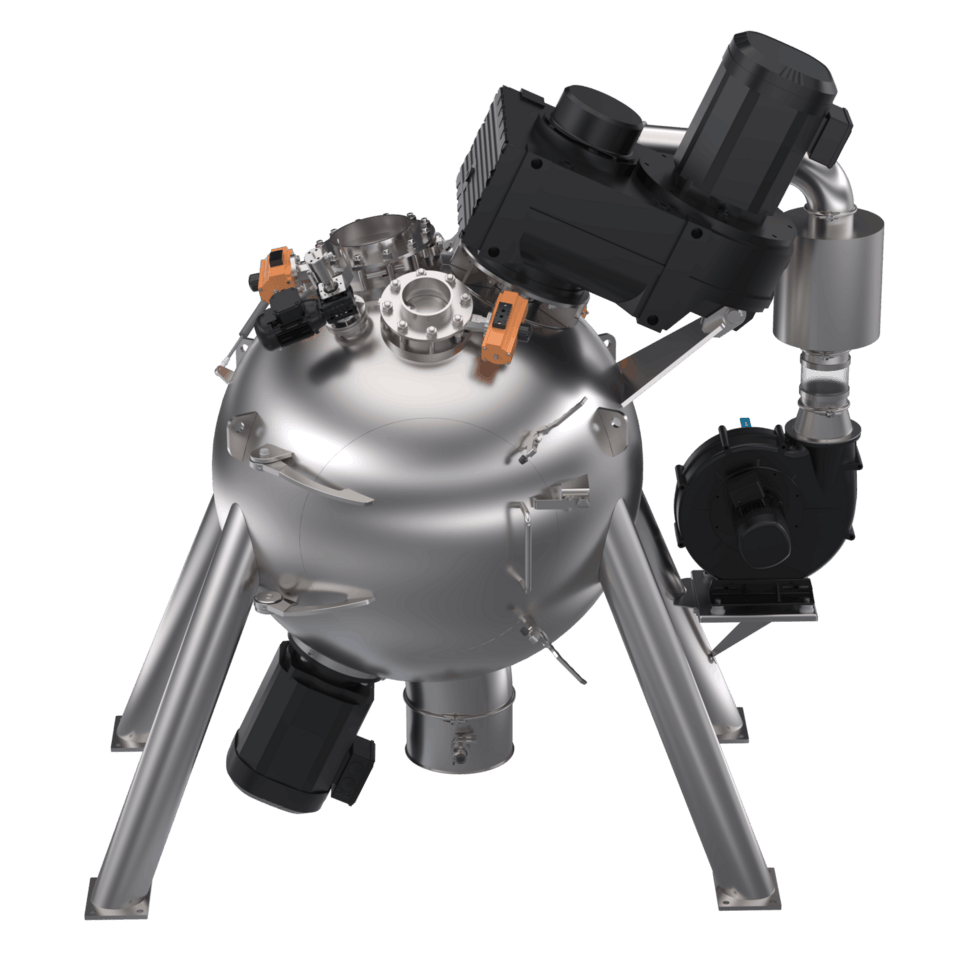

Mixing under nitrogen or in a protective atmosphere

Protection against oxidation of sensitive products and requirements for closed mixing processes in the food, nutraceuticals and speciality products industries

1. Introduction

The demands placed on industrial mixing processes are constantly increasing. Product protection, process reliability, quality preservation and reproducibility play a crucial role, particularly when processing raw materials that are sensitive to oxidation. In the food industry, the manufacture of food supplements (nutra/nutraceuticals) and in the production of speciality chemical and functional products, even contact with atmospheric oxygen can trigger undesirable changes.

Oxidation reactions can impair the sensory, chemical and functional properties of a product. Possible consequences include changes in colour, loss of flavour, fat rancidity, degradation of active ingredients and a reduced shelf life. This is particularly critical in the case of high-quality powder blends, vitamin-containing formulations, plant extracts, unsaturated fatty acids and oxygen-sensitive special formulations.

One well-established method of reducing these risks is mixing under nitrogen (N₂) or in a controlled inert gas atmosphere. This involves deliberately reducing the oxygen content within the mixing system in order to minimise oxidative reactions during processing.

However, it is not the nitrogen supply alone that is crucial. Only the combination of enclosed plant design, controlled gas flow, suitable sealing, reliable dosing and reproducible mixing technology enables effective protection against oxidation.


2. Fundamentals: Oxidation in industrial mixing processes

2.1 Causes and mechanisms of oxidation

Oxidation refers to chemical reactions in which electrons are released. When processing sensitive products, reactions involving molecular oxygen are particularly relevant. These can be accelerated by various factors, such as elevated temperatures, light, moisture, trace amounts of metals or mechanically enlarged surface areas.

Due to their large specific surface area, powdered products can be particularly sensitive to contact with oxygen. During mixing, particles are moved, dispersed and repeatedly brought into contact with the surrounding gas phase.

In the case of powders containing fat, for example, lipid oxidation may occur. This initially produces oxidation intermediates such as hydroperoxides, from which further compounds may form that impair odour, taste and product quality. Sensitive vitamins, natural colourings and plant-based ingredients may also lose their stability under unfavourable process conditions.

2.2 Typical effects

The most common oxidation-related changes in quality include:

  • Lipid oxidation: Rancidity, off-flavours and loss of quality.
  • Vitamin degradation: Reduction in the content of sensitive active ingredients.
  • Pigment oxidation: Undesirable colour changes.
  • Flavour degradation: Loss of characteristic sensory properties.
  • Oxidation of plant extracts: Alteration of functional ingredients.
  • Oxidation of reactive speciality substances: Reduced stability or processability.

The actual susceptibility to oxidation depends on the formulation, the quality of the raw materials, the temperature, the water content, exposure to oxygen and the duration of storage.

3. Mixing under nitrogen: operating principle and technical implementation

3.1 Nitrogen as an inert gas

Nitrogen is a commonly used inert gas due to its comparatively low chemical reactivity under standard mixing conditions and its industrial availability. During inerting, the oxygen-containing atmosphere in the mixing chamber is displaced or diluted by nitrogen. This lowers the partial pressure of oxygen and reduces the likelihood of certain oxidative reactions.

The aim is to maintain an atmosphere that is as constant and low in oxygen as possible throughout the entire mixing process. To achieve this, the mixing chamber must be sufficiently airtight and the nitrogen supply must be tailored to the specific process conditions.

3.2 Typical process flow

An industrial mixing process carried out under an inert atmosphere can be divided into several coordinated stages.

Sealed product feeding: The raw materials are fed into the mixing system with as little direct contact with the ambient air as possible. Depending on the plant design, sealed conveying systems, airlocks or appropriately designed dosing and feeding equipment may be used for this purpose.

Inerting of the mixing chamber: Before the mixing process begins, the air present is displaced or diluted with nitrogen. The target residual oxygen content depends on the sensitivity of the product and the safety requirements.

Controlled mixing process: The inert gas atmosphere is maintained during homogenisation. Appropriate monitoring can ensure that the specified process conditions are adhered to.

Closed discharge: Once the mixing process is complete, the product is discharged, where possible, without further contact with oxygen. The interfaces with downstream conveying systems or packaging equipment are particularly relevant in this regard.

Protected onward transport and packaging: To maintain the product quality achieved, oxygen ingress should also be minimised in the subsequent process steps.

3.3 Inertisation process

Various methods are available for the technical implementation.

In displacement purging, the existing gas atmosphere is displaced by an inflow of nitrogen. Its effectiveness depends, amongst other things, on the vessel geometry, the flow pattern and the position of the gas connections.

Dilution purging is based on a gradual reduction in the oxygen content through the introduction and mixing of nitrogen.

In the pressure cycling process, oxygen is reduced by repeatedly pressurising and depressurising the system. This requires a system that is suitable for such pressure operations.

Another option is continuous nitrogen blanketing. In this process, a defined nitrogen atmosphere is maintained during the mixing process to limit the ingress of ambient air.

The method used depends on the container geometry, the leak-tightness, the behaviour of the powder, the nitrogen consumption and the target residual oxygen content. There is no universally applicable oxygen limit. The permissible residual concentration must be determined on a product- and process-specific basis. In the case of combustible dusts, a distinction must also be made between quality-related oxidation protection and safety-related inerting.

4. Requirements for closed-loop mixing processes

Protection against oxygen requires a holistic plant design. An inertised mixing vessel alone is not sufficient if ambient air regularly enters the system during loading, dosing or emptying.

4.1 Watertightness and structural design

Closed mixing systems must be designed in such a way as to minimise uncontrolled gas ingress. Critical areas include, in particular, shaft seals, lid seals, product connections, maintenance access points and discharge devices.

Key design features include gas-tight connections – or connections that are sufficiently tight for the specific application – suitable sealing materials, defined pressure conditions and controlled gas management. It is important to bear in mind that even minor leaks can affect the quality of the protective gas. Appropriate leak testing and the monitoring of relevant process parameters are therefore essential components of the plant design.

4.2 Oxygen monitoring and process control

Continuous or batch-based oxygen measurement can help to monitor and verify the inert gas conditions.

The relevant process parameters include:

  • Residual oxygen content (O₂): Verification of the quality of the protective gas.
  • Nitrogen flow rate: Control of purging and gas supply.
  • Container pressure: Monitoring of the specified pressure conditions.
  • Product temperature: Limitation of thermal stresses.
  • Mixing time and mixing intensity: Reproducibility of homogenisation.
  • Leak-tightness: Detection of potential air ingress points.
  • Oxygen content in the product: Additional assessment for critical formulations.

Measuring the oxygen content in the gas space is not necessarily the same as measuring the oxygen trapped or dissolved in the product.

4.3 Hygiene, cleaning and protection against contamination

Particularly in the food and nutraceutical industries, inert gas processes must be compatible with hygienic plant design concepts. These include easily accessible surfaces in contact with the product, suitable surface finishes, minimised dead spaces and verifiable cleaning procedures.

Depending on the product and plant design, CIP or WIP procedures, as well as dry cleaning in line with the hygiene concept, may be relevant. A well-thought-out hygienic design helps to reduce product deposits, prevent cross-contamination and create reproducible cleaning conditions.

4.4 Safety requirements

Nitrogen is non-flammable; however, it can displace oxygen from the ambient air and thereby pose a risk of asphyxiation. Therefore, adequate room ventilation, oxygen warning systems where necessary, and a safely designed gas extraction system are required.

In the case of explosive dust atmospheres, the relevant explosion protection requirements must also be taken into account. A residual oxygen content sufficient to prevent oxidation must not automatically be regarded as safe from an explosion protection perspective. The relevant limit values must be determined on the basis of the specific substance and process conditions.

4.5 ATEX and explosion protection in inerted mixing processes

When processing combustible powders and bulk materials, in addition to protection against oxidation, the requirements for explosion protection in accordance with the European ATEX Directives 2014/34/EU and 1999/92/EC must also be taken into account. Explosive dust-air mixtures may form, particularly during feeding, homogenisation and discharge.

Targeted nitrogen inerting can reduce the oxygen content within the mixing system to such an extent that the formation of an explosive atmosphere can be prevented uander defined operating conditions. A prerequisite for this is ensuring that the substance-specific oxygen limit concentration (SGK) is reliably maintained below the threshold, whilst observing appropriate safety distances, as well as continuous or otherwise technically suitable monitoring of the process atmosphere. The necessary protective measures must be defined as part of a plant- and process-specific explosion risk assessment. In particular, potential air ingress, disruptions to the nitrogen supply, ignition sources, and start-up, shut-down and cleaning processes must be taken into account.

A nitrogen atmosphere does not, therefore, generally replace the ATEX-compliant design of the plant equipment used; however, it can be integrated into a holistic safety concept as an effective explosion protection measure. Particularly in the case of closed mixing systems, the combination of controlled inerting, suitable measurement technology and a plant design tailored to safety requirements offers the opportunity to combine product protection with explosion safety.

5. Applications in food, nutritional and speciality products

Spoons with various ground spices on a light blue background

5.1 Food – Lebensmittelindustrie

In the food industry, the protection of raw materials susceptible to oxidation plays a key role in sensory quality and shelf life.

Modified atmosphere packaging is particularly relevant for full-fat milk powders, cocoa products, flavourings, spice blends and functional food ingredients.

During the mixing process, oxygen can react with sensitive product components, thereby promoting the formation of undesirable odours and flavours.

A suitable nitrogen atmosphere can reduce contact with oxygen during processing. This can help to stabilise product quality and improve the conditions for a longer shelf life.

Running figure formed from tablets and capsules

5.2 Nutra – Dietary supplements

High-quality and sensitive ingredients are frequently used in the manufacture of food supplements.

These include vitamins, plant extracts, powders containing omega-3 and combinations of functional active ingredients.

A controlled process atmosphere can help to limit the degradation of oxidation-sensitive ingredients during processing.

In addition to protection against oxidation, the key priorities in this area are, in particular, high mixing homogeneity, minimal product losses, hygienic processing and reproducible batch quality.

5.3 Speciality products – sophisticated formulations

A protective gas atmosphere may also be required for specialised chemical and functional products.

Examples include reactive additives, sensitive pigments, functional chemicals and specialised powder formulations.

Depending on the properties of the material, inerting can help to limit undesirable reactions with atmospheric oxygen.

For certain products, additional requirements regarding moisture exclusion, temperature control and explosion protection must also be taken into account. The technical design should therefore always be based on a detailed assessment of the relevant product and process requirements.

6. Economic and qualitative benefits

Appropriate nitrogen inerting can offer economic benefits as well as protecting the product. These depend largely on the sensitivity of the formulation and the design of the overall process.

The potential benefits include lower oxidative stress on the product, reduced quality deviations, less waste, improved batch consistency and greater process reliability.

On the other hand, there are investments in gas supply, measurement technology, sealing and automation, as well as running costs for nitrogen and plant operation. A technical and economic assessment should therefore take the entire process chain into account.

It is particularly important to ensure coordinated process development, in which mixing quality, product protection, inert gas consumption and cleaning are considered together.

GloMix GLM 1300 mixer with CIP nozzle, block flanges and drying system

7. GloMix – Mixing technology for demanding inert gas processes

In the industrial sector, the integration of inert gas processes into modern mixing plants is becoming increasingly important. For GloMix, this represents a significant area of application, particularly when processing high-quality and oxidation-sensitive powdered products.

The key question is how to combine high mixing quality with controlled oxygen input, a closed-loop process control system and a cost-effective plant design.

7.1 Requirements for mixing techniques

When designing mixing solutions for food, nutritional and specialised products, several technical aspects must be taken into account.

Closed-system operation: The plant should be designed in such a way that product feeding, the mixing process and discharge can take place with as little contact with the ambient air as possible.

Integration of a nitrogen supply: For inert gas applications, suitable connections, a defined gas supply and, where necessary, controlled gas venting are required.

Gentle homogenisation: The mixing technology must enable the components to be distributed evenly without subjecting sensitive raw materials to unnecessary thermal or mechanical stress.

Hygienic design: Particularly for foodstuffs and food supplements, it is important to use suitable materials, designs that facilitate cleaning, and to prevent product deposits in hard-to-reach areas.

Automation and process documentation: The recording of relevant parameters such as mixing time, temperature, pressure and oxygen concentration can support quality assurance.

7.2 Potential areas of application for GloMix

In the Food sector, the focus is particularly on the protection of high-quality food ingredients. These include, for example, flavourings, fat powders and sensitive powder mixtures.

In the Nutra sector, the gentle processing of sensitive vitamins, functional ingredients and plant extracts, as well as reproducible homogenisation, are of particular importance.

For specialised products, a controlled process atmosphere can help to stabilise sensitive formulations and limit undesirable reactions.

Furthermore, the integration of closed process lines is becoming increasingly important. In this context, dosing, mixing, discharge and onward transport are regarded as interlinked process steps.

For GloMix, inert gas processing can therefore serve as a starting point for addressing customer-specific requirements for modern powder mixing processes.

7.3 Technological perspective

The development of industrial mixing processes is increasingly characterised by the combination of product protection, automation, energy efficiency, hygienic design and process data monitoring.

For GloMix, a holistic view of the mixing process is particularly important. The technical benefits of an inert gas application do not arise solely from the introduction of nitrogen, but from the coordination of all components throughout the process chain. In this context, the mixing tool, vessel geometry, sealing systems, gas supply, measurement technology and product discharge must be regarded as an integrated system.

Key areas of technological development include demand-based nitrogen dosing, the reduction of gas losses, the integration of smart sensor technology, and the digital monitoring of critical process parameters. The specific implementation depends on the mixing technology used, the product characteristics and the technical capabilities of the plant in question.

8. Conclusion and Outlook

Mixing under nitrogen or in a protective atmosphere is an important process engineering method for protecting oxidation-sensitive products during industrial processing.

Particularly in the food, nutraceutical, and specialty products sectors, the controlled reduction of oxygen ingress can make a significant contribution to maintaining product quality, active ingredient stability, and sensory properties.

This requires a holistic approach to process management. In addition to the actual inerting process, the leak-tightness of the mixing system, closed-loop feeding and discharge, oxygen monitoring, and hygienic and safety-oriented design are of crucial importance.

For GloMix, exploring inert gas processes opens up the opportunity to systematically incorporate the requirements of demanding customer applications into the development and design of modern mixing solutions.

The key insight is this: Effective protection against oxidation does not begin with the introduction of nitrogen, but rather with a consistently closed and controlled design of the entire mixing process.

Kontakt